
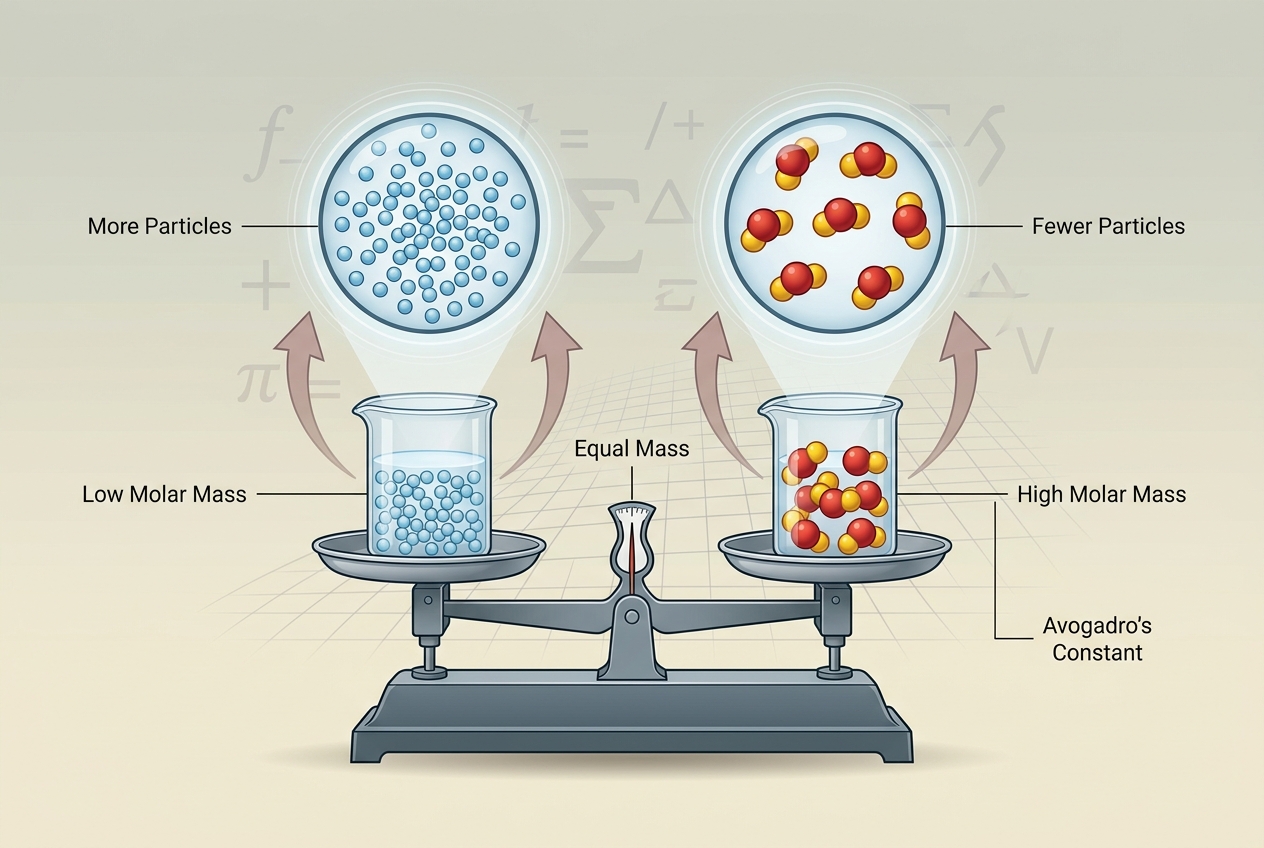
Chemistry: Mole Concept: Comparing Particles in 4g of Helium vs Sulfur Dioxide
The mole concept is the chemist’s bridge between the macroscopic world of grams and the microscopic world of atoms and molecules. At its heart lies Avogadro’s constant (6.022 × 10²³ mol⁻¹), which defines exactly how many particles are contained in one mole of any substance. This fixed number allows us to convert between mass, moles, and particle count using the simple relationship n = m / M, where n is the number of moles, m is the mass in grams, and M is the molar mass. Understanding this relationship is essential because equal masses of different substances do not contain equal numbers of particles. As the marking scheme highlights, the molar mass of a compound like SO₂ is found by summing the atomic masses of its elements (S + 2O). Comparing two samples of the same mass but different molar masses reveals that the substance with the smaller molar mass yields more moles—and therefore more particles—since each mole contributes the same Avogadro’s number of entities. This direct proportionality between moles and particle count is the key insight: the mole acts as a counting unit, scaling the invisible world of atoms into measurable quantities.
Start practising IB questions today
150,000+ IB-styled questions, criteria-mapped and instantly accessible.