
Chemistry: Multi-Criteria Decisions in Water Treatment Chemistry
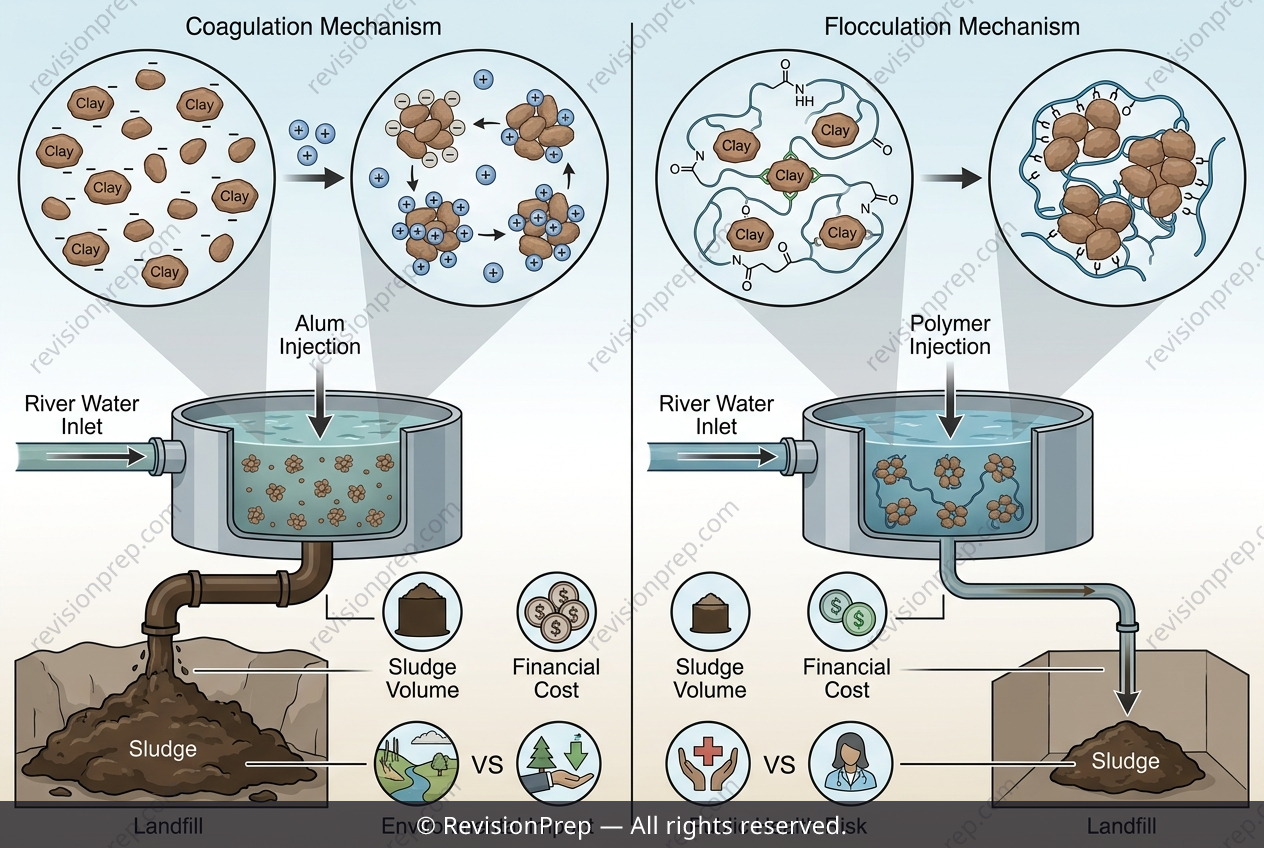
Water purification is rarely a simple case of removing one pollutant—it is a balancing act between chemistry, cost, and environmental impact. At the heart of this lies multi-criteria decision analysis, a framework that forces us to weigh competing factors rather than chase a single “best” answer. In the context of a municipal treatment plant, the choice between aluminium sulfate (alum) and a polymer-based flocculant illustrates this perfectly. Alum works by dissolving into Al³⁺ ions, which neutralise the negative surface charges on suspended clay particles. This removes the electrostatic repulsion keeping them apart, allowing them to collide and clump into settleable aggregates—a process called coagulation. The polymer, by contrast, uses long-chain molecules that physically adsorb onto multiple particles at once, bridging them into larger, denser flocs. Both achieve the same outcome—particle removal—but through fundamentally different mechanisms: charge neutralisation versus physical bridging. The trade-off emerges when you compare their consequences. The polymer costs 40% more per kilogram, yet it generates 80% less toxic sludge, reducing landfill burden and disposal fees. Lower dose rates may also shrink the per-litre cost gap. Meanwhile, alum’s cheap upfront price hides the hidden expense of hazardous waste management. Understanding these interconnected relationships—dose, sludge volume, price, and environmental liability—is what turns a simple chemical choice into a genuine multi-criteria decision.
Start practising IB questions today
150,000+ IB-styled questions, criteria-mapped and instantly accessible.