
Chemistry: One Formula, From Factory to Farm
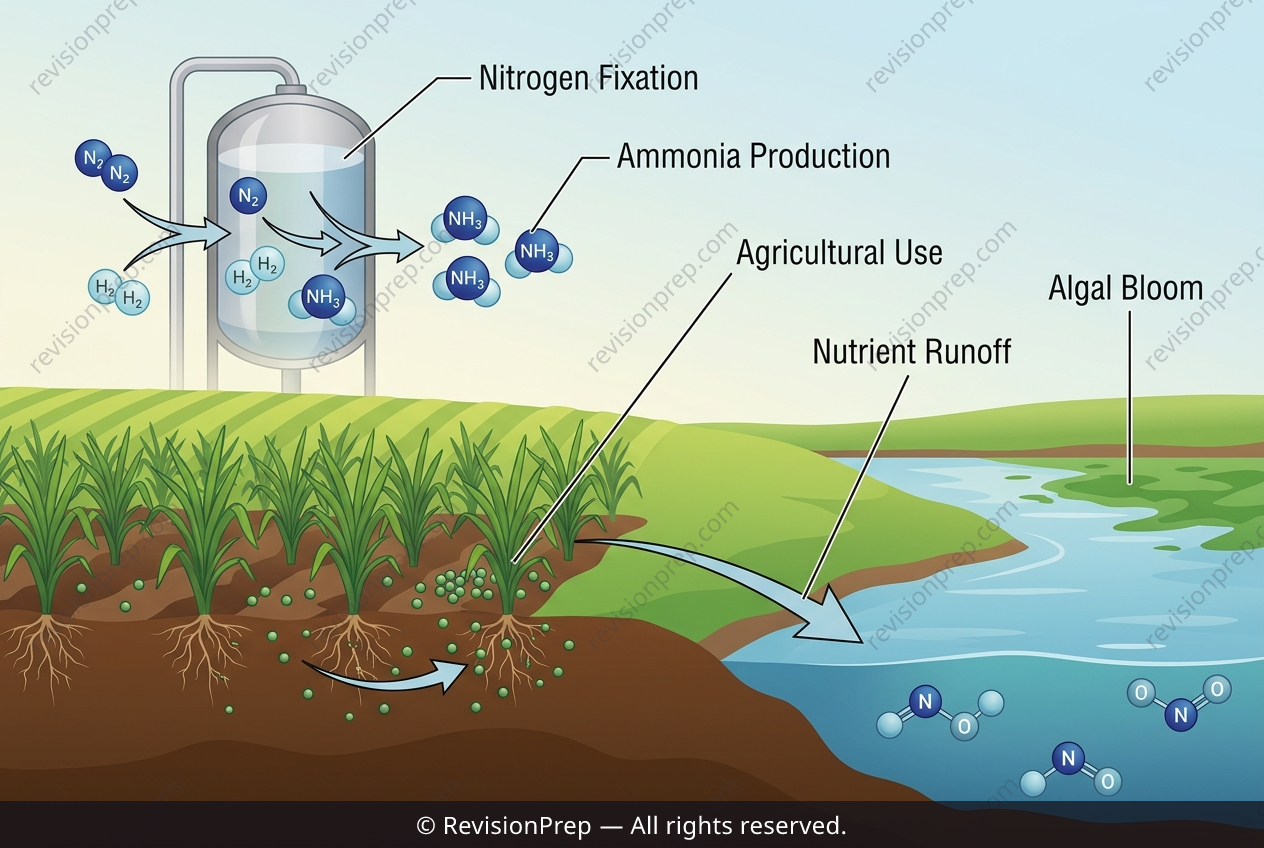
The mole is the chemist’s bridge between the microscopic world of atoms and the macroscopic world of grams and litres. In this core topic, you’ll learn that the amount of a substance, n, is found by dividing its mass by its molar mass (n = m/M), a relationship that turns a simple weighing into a precise count of particles. This is the foundation for understanding stoichiometry—the quantitative ratios in which chemicals react, as seen in the Haber process for ammonia production. Why does this matter beyond the lab? Because industrial chemistry, like fertilizer synthesis, operates on a massive scale, and every gram counts—both economically and environmentally. The same mole calculation that tells a factory how much nitrogen to feed into a reactor also tells a farmer how much ammonia to apply to a field. When that calculation is ignored, excess nitrate runoff triggers eutrophication: algal blooms, then bacterial decay, then oxygen depletion that suffocates aquatic life. Thus, the mole is not just a number—it’s a tool for balancing productivity with planetary health, connecting a simple formula to a complex ecological chain.
Start practising IB questions today
150,000+ IB-styled questions, criteria-mapped and instantly accessible.