
Chemistry: Redox Displacement: Zinc and Copper Sulfate Explained
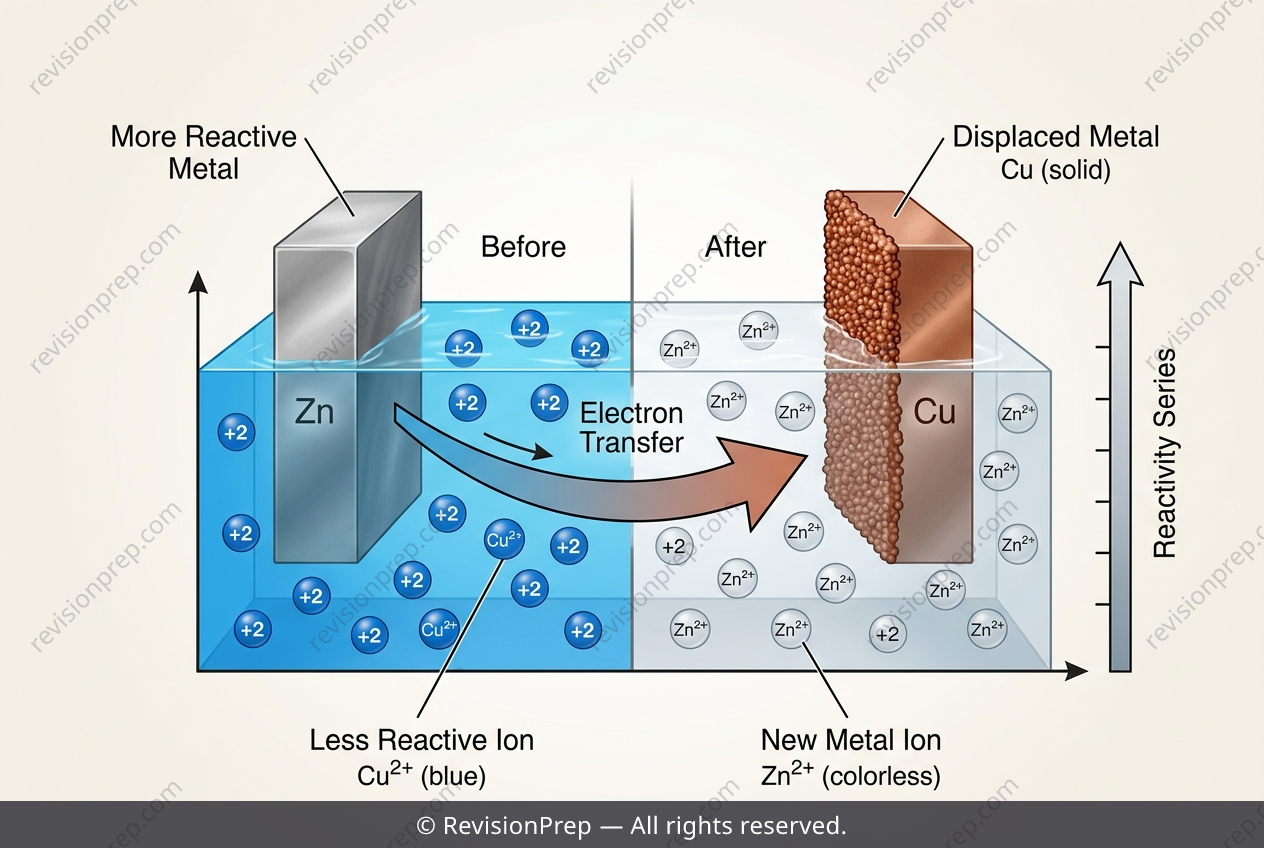
When a strip of zinc metal is dropped into a blue copper sulfate solution, you are witnessing one of the most visually satisfying demonstrations in chemistry: a single displacement reaction. This process, central to the study of chemical reactivity, hinges on the relative willingness of metals to lose electrons. In this case, the zinc atoms give up electrons to become zinc ions, while the copper ions in solution accept those electrons to revert to neutral, solid copper atoms. The reaction can be summarised as Zn(s) + CuSO₄(aq) → ZnSO₄(aq) + Cu(s), but the real story lies in the colour and the solid that appears. Understanding this reaction is not just about memorising a sequence; it is about connecting observable evidence to the underlying principle of the reactivity series. The disappearance of the solution’s blue colour—caused by hydrated copper(II) ions—tells you those ions are being removed from the solution, converted into the reddish-brown solid coating the zinc. This colour change is your proof that zinc is the more reactive metal, as it successfully displaces copper from its compound. By tracing where the ions go and what happens to their colour, you unlock the logic behind why some metals replace others in solution, a concept that underpins everything from rust prevention to battery design.
Start practising IB questions today
150,000+ IB-styled questions, criteria-mapped and instantly accessible.