
Chemistry: Same Count, Different Mass
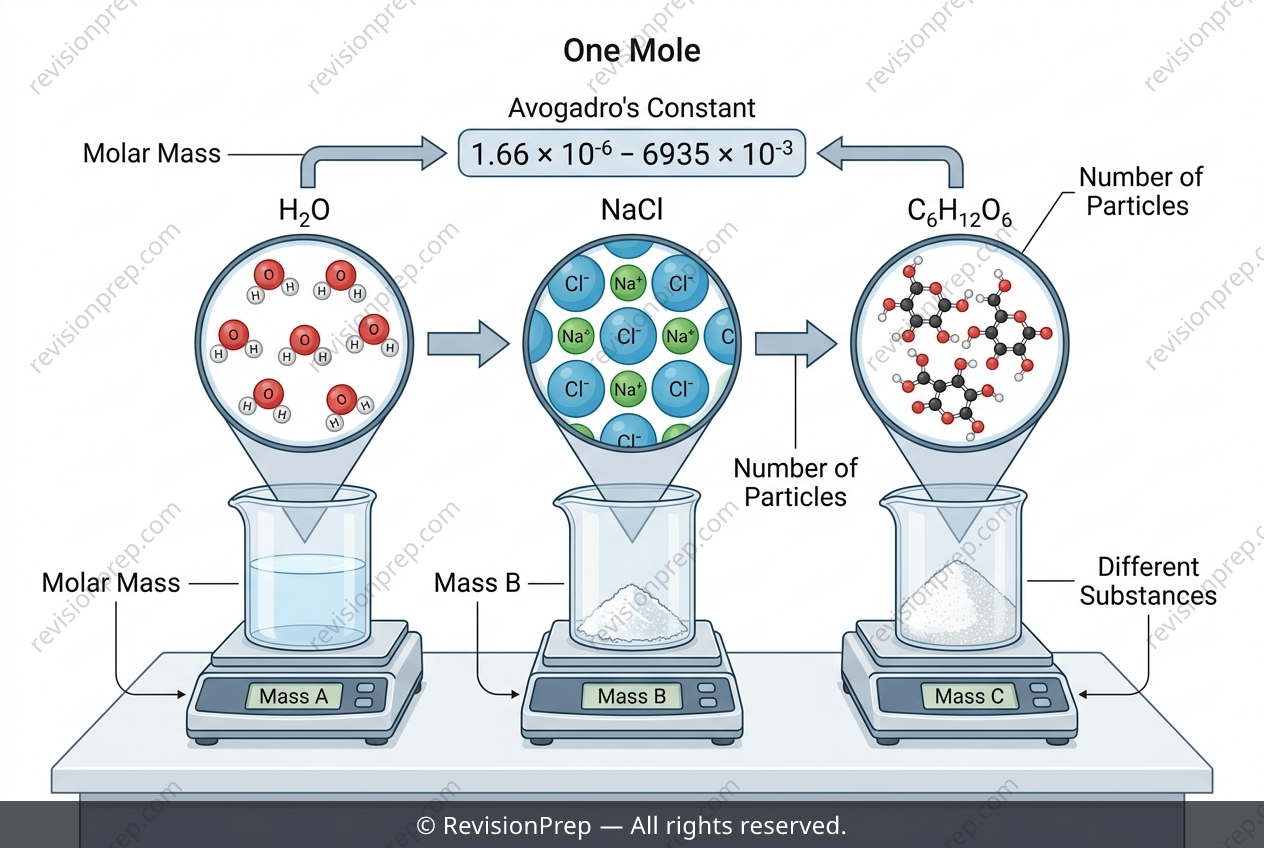
One mole is a fixed counting unit, not a measure of mass: it always contains exactly 6.022 × 10²³ particles, a number known as Avogadro’s constant (Nₐ). This single idea underpins nearly every quantitative calculation in chemistry, because it links the invisible world of atoms and molecules to the measurable world of grams and balances. Without it, you couldn’t convert between the mass of a substance you weigh in the lab and the number of particles reacting in a beaker. The key relationship is molar mass (g mol⁻¹), which tells you the mass of exactly one mole of a substance. For water, that’s the sum of its atomic masses; for sodium chloride, it’s different again. Yet—and this is the crucial point—one mole of water, one mole of salt, and one mole of glucose all contain the identical number of particles, even though their molar masses differ wildly. The mole is substance-independent for particle count, but substance-specific for mass. So a larger molar mass means each individual particle is heavier, not that there are more of them. Understanding this distinction prevents a classic confusion: mass and particle number are separate properties, connected only through Nₐ.
Start practising IB questions today
150,000+ IB-styled questions, criteria-mapped and instantly accessible.