
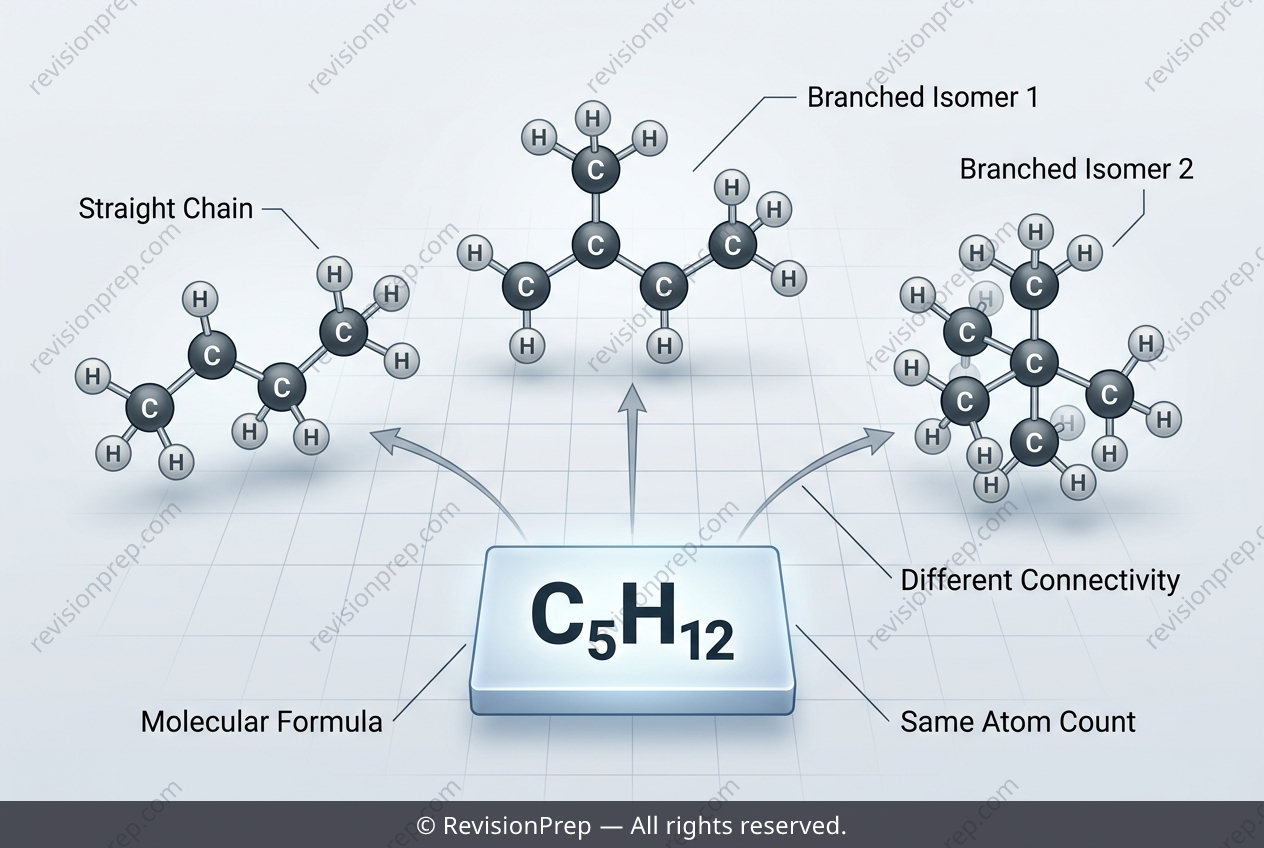
Chemistry: Same Formula, Different Skeletons
Structural isomerism is the phenomenon where two or more compounds share the same molecular formula but differ in the connectivity of their atoms. For a saturated hydrocarbon like C₄H₁₀, this means the carbon skeleton can be arranged as a continuous chain or as a branched chain, while still obeying the general alkane formula CₙH₂ₙ₊₂. This concept is foundational in organic chemistry because it explains why a single molecular formula can correspond to multiple distinct substances with different physical and chemical properties. The key to identifying structural isomers lies in systematically rearranging the carbon framework without altering the number of each atom. For C₄H₁₀, the straight-chain arrangement places all four carbons in a row, whereas the branched arrangement places three carbons in a chain with the fourth attached as a substituent to the middle carbon. Both structures satisfy the same degree of saturation, yet they are not superimposable. Understanding this distinction helps students predict boiling points, reactivity, and naming conventions, and it forms the basis for more complex isomerism in later topics.
Start practising IB questions today
150,000+ IB-styled questions, criteria-mapped and instantly accessible.