
Chemistry: Stoichiometry Meets Real Emissions
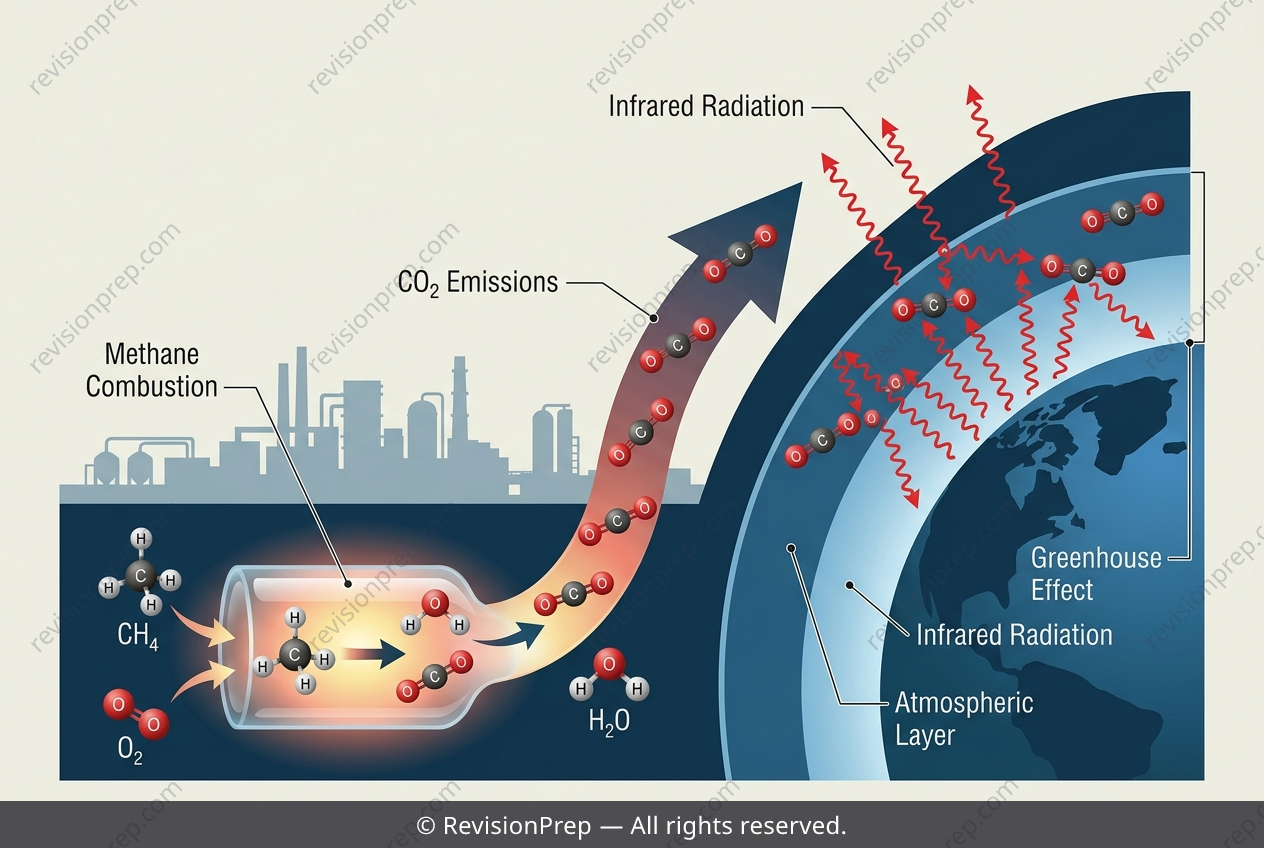
Stoichiometry is the quantitative language of chemistry—the set of relationships that lets us translate between the mass of a reactant we weigh out and the mass of a product we expect to form. At its heart lies the mole, a fixed count of particles (6.022 × 10²³), which links the microscopic world of atoms and molecules to the macroscopic world of grams and kilograms. For any balanced equation, the coefficients give the mole ratio between substances, so by converting mass to moles (n = m / M), applying that ratio, and converting back to mass, we can predict yields with precision. This matters far beyond the lab. In atmospheric chemistry, the same stoichiometric logic underpins our understanding of industrial emissions—like the combustion of methane in excess oxygen, where one mole of fuel yields one mole of carbon dioxide. The calculation itself is straightforward: find the molar mass of methane, divide the daily mass by it, then multiply by the molar mass of CO₂. But the real insight comes from evaluating the result. That predicted mass represents an ideal maximum, assuming complete combustion. In practice, incomplete burning produces carbon monoxide and soot, while the greenhouse effect itself depends on CO₂’s ability to absorb and re-radiate infrared radiation. Thus, the balanced equation is a powerful starting point—but its reliability hinges on the gap between ideal stoichiometry and real-world conditions.
Start practising IB questions today
150,000+ IB-styled questions, criteria-mapped and instantly accessible.