
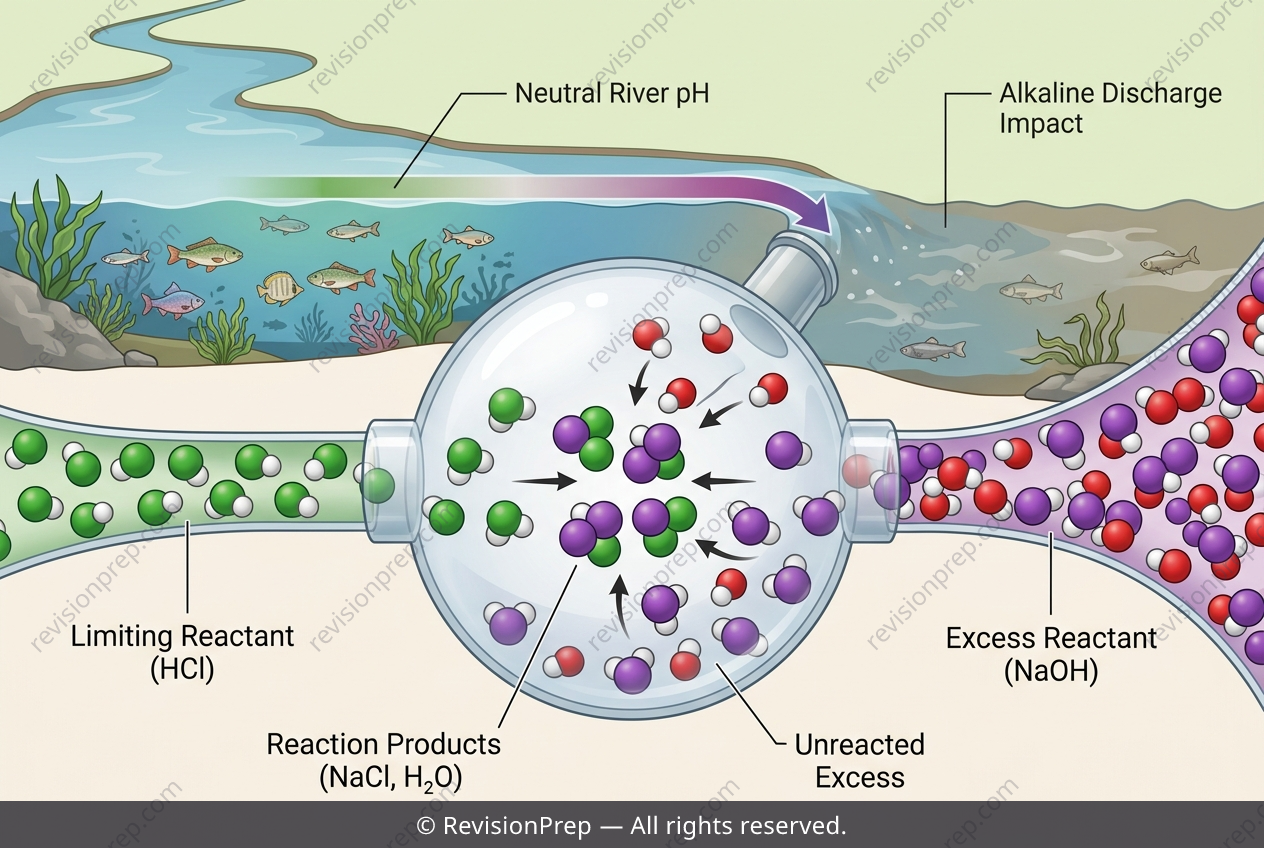
Chemistry: Stoichiometry Meets Wastewater pH
Stoichiometry is the quantitative relationship between reactants and products in a chemical reaction, and mastering it allows chemists to predict exactly how much of each substance is consumed or produced. In this context, the neutralisation of hydrochloric acid by sodium hydroxide follows a simple 1:1 mole ratio, meaning that for every mole of HCl, one mole of NaOH is required. By converting the given masses into moles using molar masses (36.46 g mol⁻¹ for HCl and 40.01 g mol⁻¹ for NaOH), you can determine the precise amount of NaOH needed to react completely with the acid. This calculation matters because real-world industrial processes rarely use perfect amounts—one reactant is often added in excess to ensure the other is fully consumed. Here, the excess NaOH remains unreacted in the wastewater, and its environmental impact hinges on pH. Since NaOH is a strong base, leftover amounts raise the discharge pH above the safe regulatory range of 6.5–8.5. Elevated alkalinity can damage fish gill membranes, impair gas exchange, and disrupt enzyme function in aquatic organisms. The connection between stoichiometry and environmental chemistry is direct: the mole ratio dictates how much base remains, and that leftover mass determines the ecological risk. Understanding this link helps you see why precise calculations are not just academic—they have real consequences for river ecosystems.
Start practising IB questions today
150,000+ IB-styled questions, criteria-mapped and instantly accessible.