
Chemistry: Stoichiometry Saves an Acidic Lake
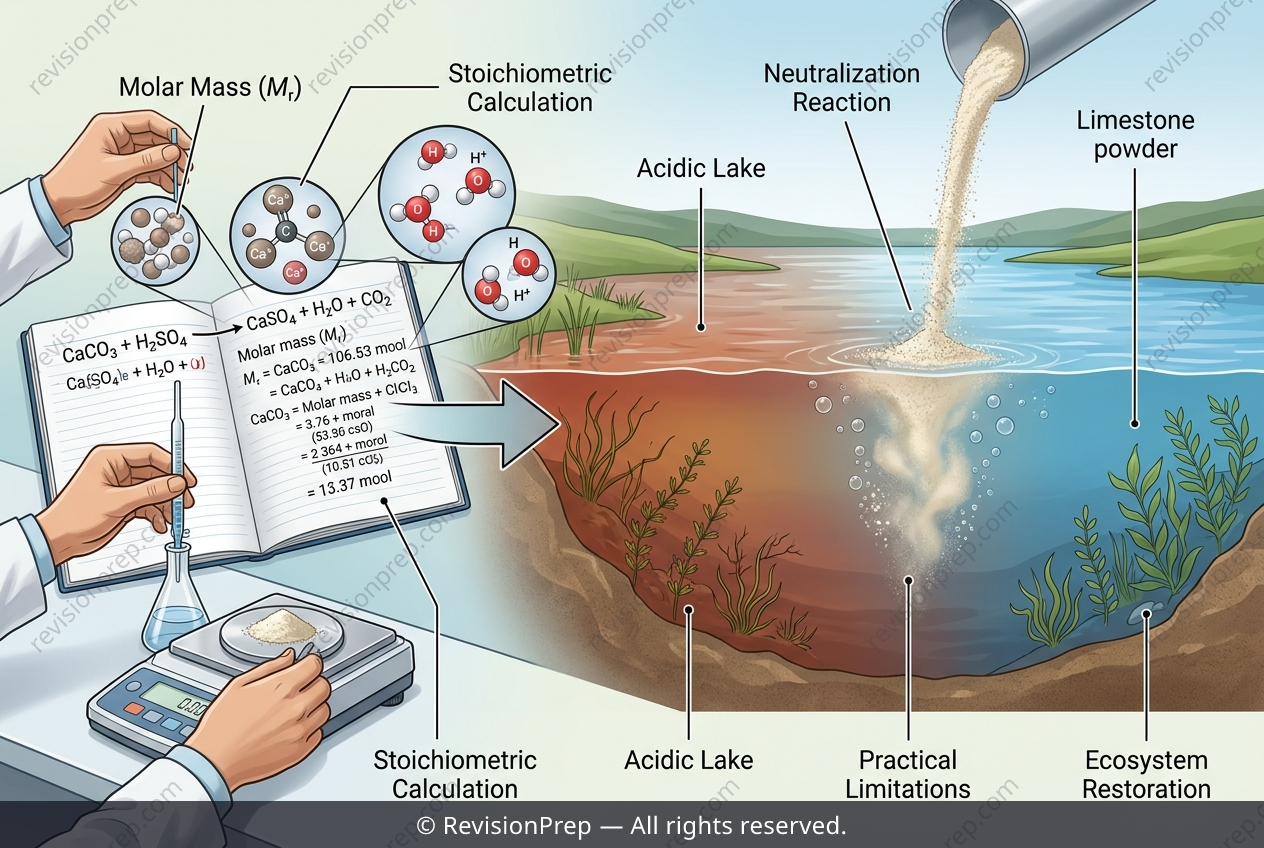
Stoichiometry is the language of chemical quantities, and nowhere is it more practically vital than in environmental remediation. When an acidic lake threatens aquatic life, crushed limestone (calcium carbonate, CaCO₃) is often the treatment of choice. The core concept here is relative formula mass (Mᵣ): the sum of the average atomic masses of all atoms in a formula unit. For CaCO₃, this value is 100, a seemingly simple number that unlocks the entire planning process. Knowing Mᵣ = 100 allows chemists to convert between the mass of limestone added and the number of moles of CaCO₃ available to react. Using the balanced neutralisation equation (CaCO₃ + H₂SO₄ → CaSO₄ + H₂O + CO₂), they can then apply the stoichiometric ratio—one mole of limestone neutralises one mole of sulfuric acid—to calculate the exact mass of rock needed for a given acid load. This precision prevents under-treatment (leaving the lake acidic) or over-treatment (wasting material and money). However, the theoretical Mᵣ assumes pure CaCO₃. Natural limestone contains impurities like MgCO₃ or SiO₂, which change the effective Mᵣ of the sample. This deviation means the calculated dose becomes inaccurate, reducing the real-world effectiveness of the treatment—a key limitation that links laboratory precision to field complexity.
Start practising IB questions today
150,000+ IB-styled questions, criteria-mapped and instantly accessible.