
Chemistry: The Bubble Test for Hidden Isomers
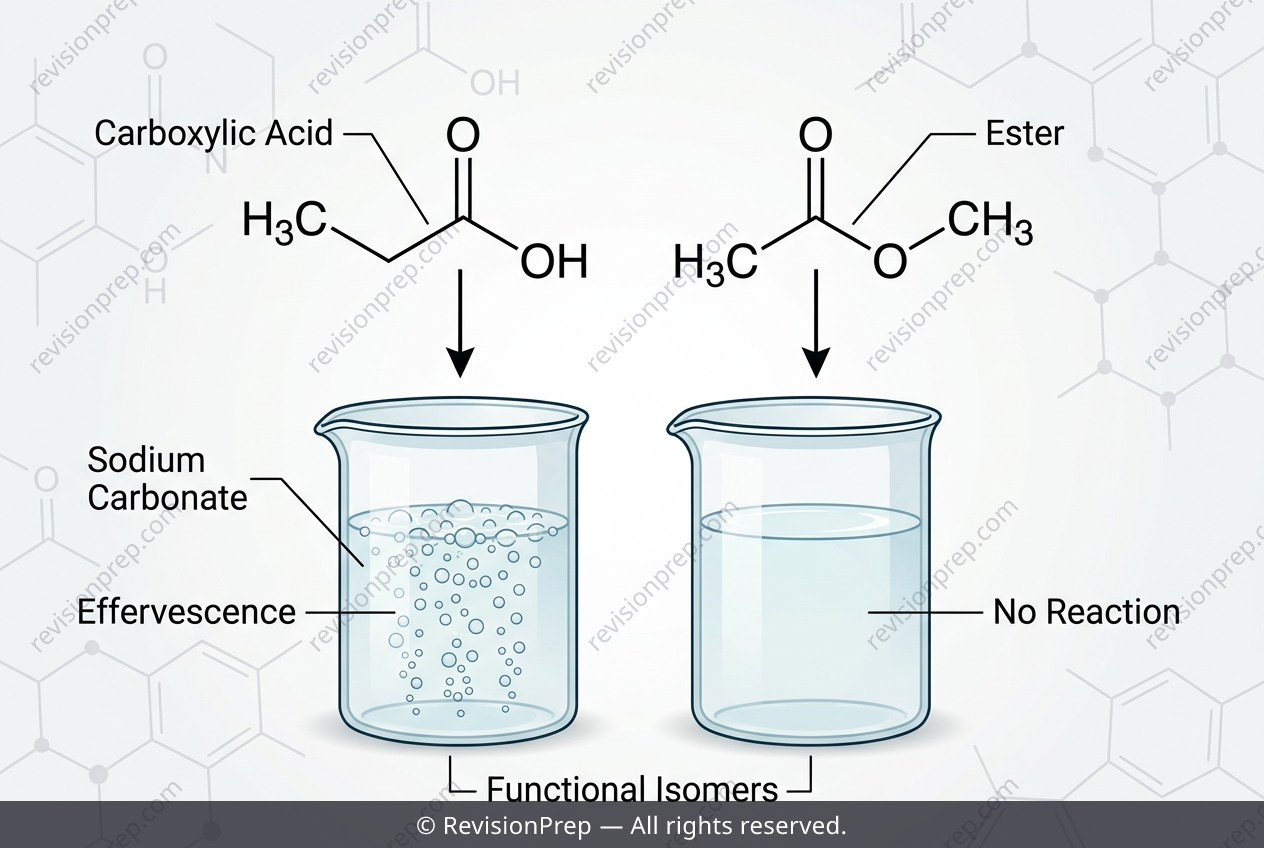
One molecular formula can hide two very different chemical personalities. In organic chemistry, compounds that share the same atoms but arrange them differently are called isomers, and when that rearrangement creates entirely new functional groups, we call them functional group isomers. The formula C₃H₆O₂ is a classic example: it can be written as propanoic acid, which contains a carboxyl group (–COOH), or as methyl ethanoate, which contains an ester linkage (–COO–). Though their atom counts are identical, their chemical behaviour diverges sharply. The key to this divergence lies in acidity. Carboxylic acids are weak acids, capable of donating a proton to a base like sodium carbonate (Na₂CO₃), producing carbon dioxide gas as a visible effervescence. Esters, in contrast, lack that acidic hydrogen and remain inert under the same conditions. This differential reactivity is not just a lab curiosity—it is a powerful diagnostic tool. By observing whether a compound fizzes with a carbonate solution, you can identify which functional group is present, even when the molecular formula alone is ambiguous. Understanding this relationship between structure, functional group, and reactivity is central to predicting and explaining the behaviour of organic molecules.
Start practising IB questions today
150,000+ IB-styled questions, criteria-mapped and instantly accessible.