
Chemistry: The Enhanced Greenhouse Effect and Methane Sources
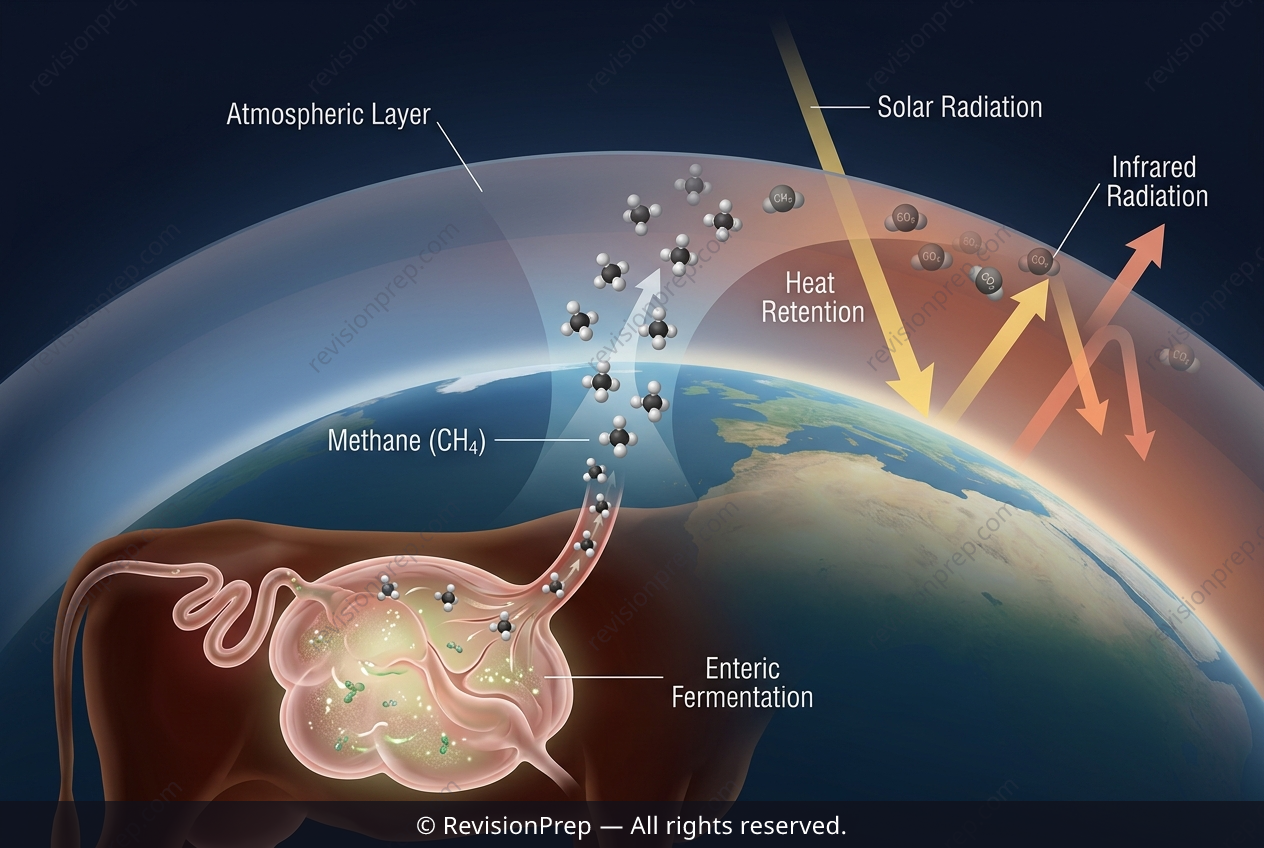
Methane from cattle farming is far more than just a by-product of digestion; it is a potent greenhouse gas that plays an outsized role in accelerating global warming. While carbon dioxide (CO₂) remains the most abundant long-lived greenhouse gas, methane (CH₄) is roughly 28 times more effective at trapping heat over a 100-year period. This means that even relatively small emissions of CH₄ can have a disproportionately large impact on the Earth’s energy balance. The mechanism behind this impact lies in how methane interacts with radiation. Incoming sunlight warms the Earth’s surface, which then re-emits that energy as infrared radiation. Methane molecules in the atmosphere absorb this outgoing infrared radiation and re-radiate a portion of it back toward the surface. This process—known as the enhanced greenhouse effect—traps additional heat, raising global temperatures and driving climate change. Because cattle produce methane through enteric fermentation and manure decomposition, livestock farming becomes a major contributor. However, efforts to curb these emissions face real-world hurdles: feed additives that reduce methane are costly, and shrinking herd sizes threatens farmers’ livelihoods and food security, creating a tension between environmental goals and economic realities.
Start practising IB questions today
150,000+ IB-styled questions, criteria-mapped and instantly accessible.