
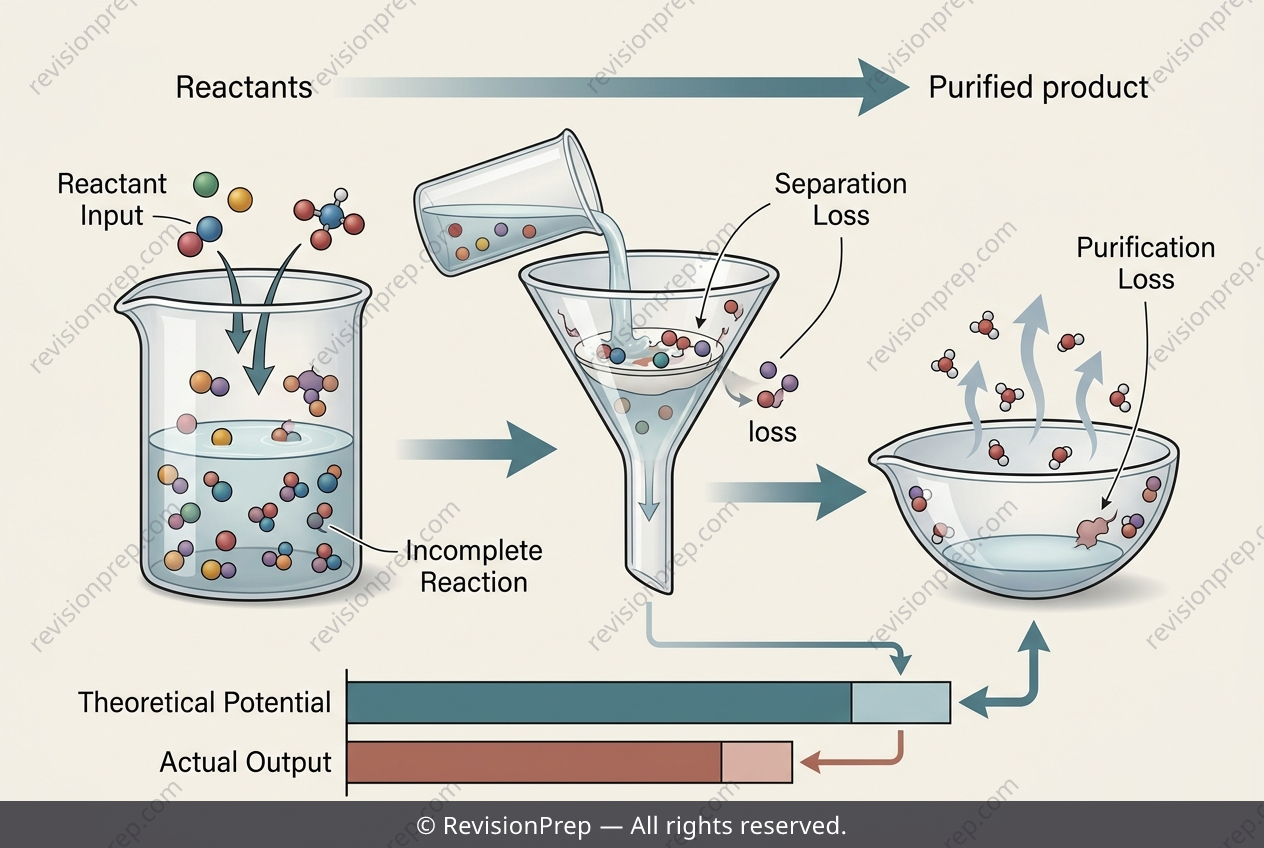
Chemistry: The Gap Between Theory and Yield
In chemistry, reactions are rarely perfect, and the gap between what we predict and what we actually obtain is the heart of reaction efficiency. Percentage yield is the metric that quantifies this gap, calculated as the ratio of the actual mass of product collected to the theoretical maximum predicted by stoichiometry, multiplied by 100%. This simple formula—percentage yield = (actual yield / theoretical yield) × 100%—reveals not just a number, but the practical limitations of laboratory work. The concept matters because it bridges the ideal world of balanced equations with the messy reality of beakers, filter paper, and evaporation. In a typical preparation, such as synthesizing copper sulfate crystals from excess copper(II) oxide and sulfuric acid, the theoretical yield assumes perfect recovery. Yet, the actual yield is almost always lower. This shortfall stems from two interconnected sources: physical losses during transfer and filtration, where crystals cling to glassware, and incomplete crystallisation, where dissolved product remains in the filtrate. Understanding these losses connects the formula to the procedure, showing that yield is not just a calculation but a diagnostic tool for experimental technique.
Start practising IB questions today
150,000+ IB-styled questions, criteria-mapped and instantly accessible.