
Chemistry: the Ideal Gas Law: PV=nRT Practice for IB Chemistry SL
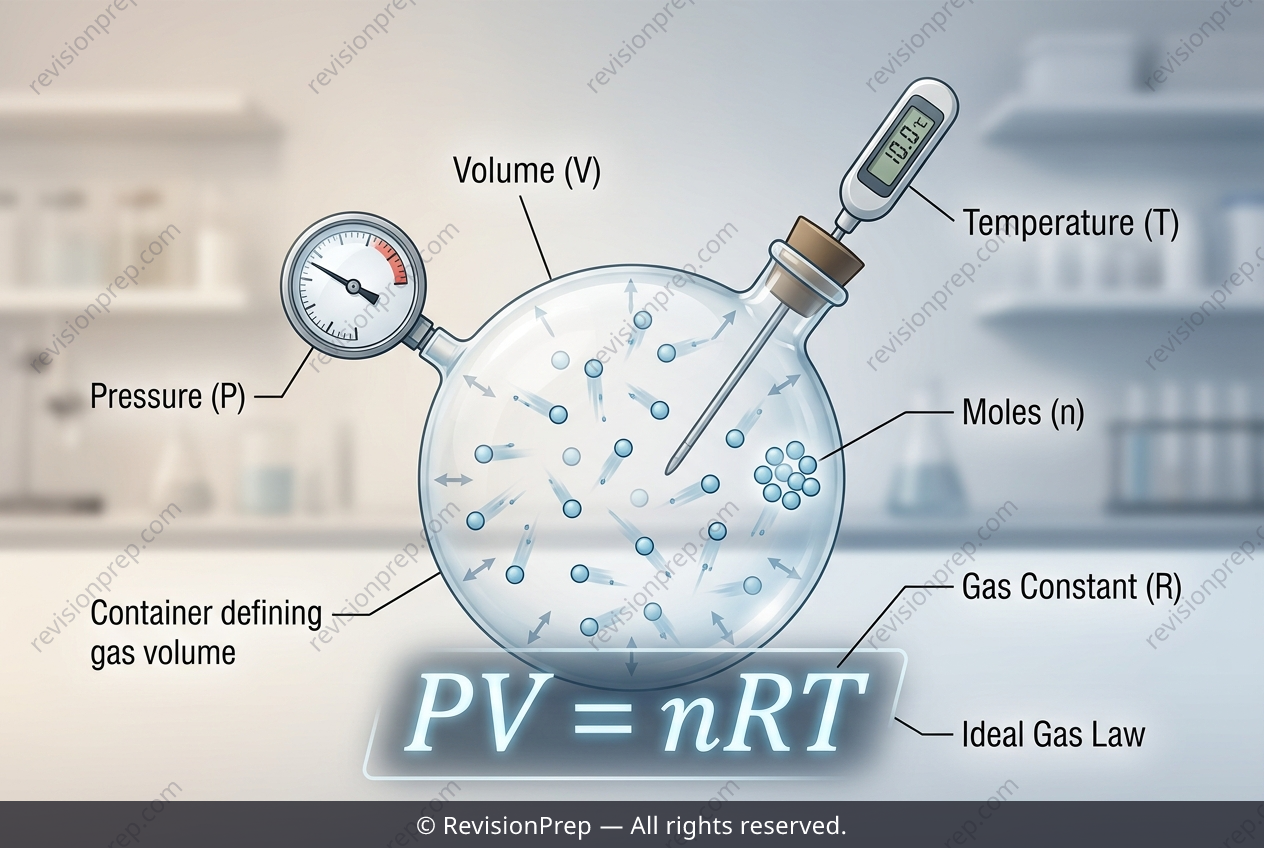
The ideal gas law, PV = nRT, is the cornerstone of understanding how gases behave under changing conditions. It links four fundamental properties—pressure (P), volume (V), amount in moles (n), and temperature (T)—into a single, elegant equation, with R acting as the universal constant that ties them together. For IB Chemistry SL students, this model is essential because it allows you to predict the state of a gas when you know just three of its variables, bridging the microscopic world of particles with macroscopic measurements you can take in a lab. What makes this law powerful is its reliance on consistent units. Notice that R is given in joules per mole per kelvin, which means volume must be in cubic metres (m³) and pressure in pascals (Pa) for the equation to work. A common trap is forgetting that 1 dm³ equals 1 × 10⁻³ m³—a simple conversion that changes your result by a factor of 1000. When you rearrange the formula to solve for pressure (P = nRT/V), every term connects: more moles or higher temperature push pressure up, while a larger volume spreads the particles out, lowering pressure. Understanding this relationship not only helps you solve numerical problems but also deepens your intuition for how real gases respond to compression, heating, or expansion.
Start practising IB questions today
150,000+ IB-styled questions, criteria-mapped and instantly accessible.