
Chemistry: The Mole—Bridging Atoms & Grams
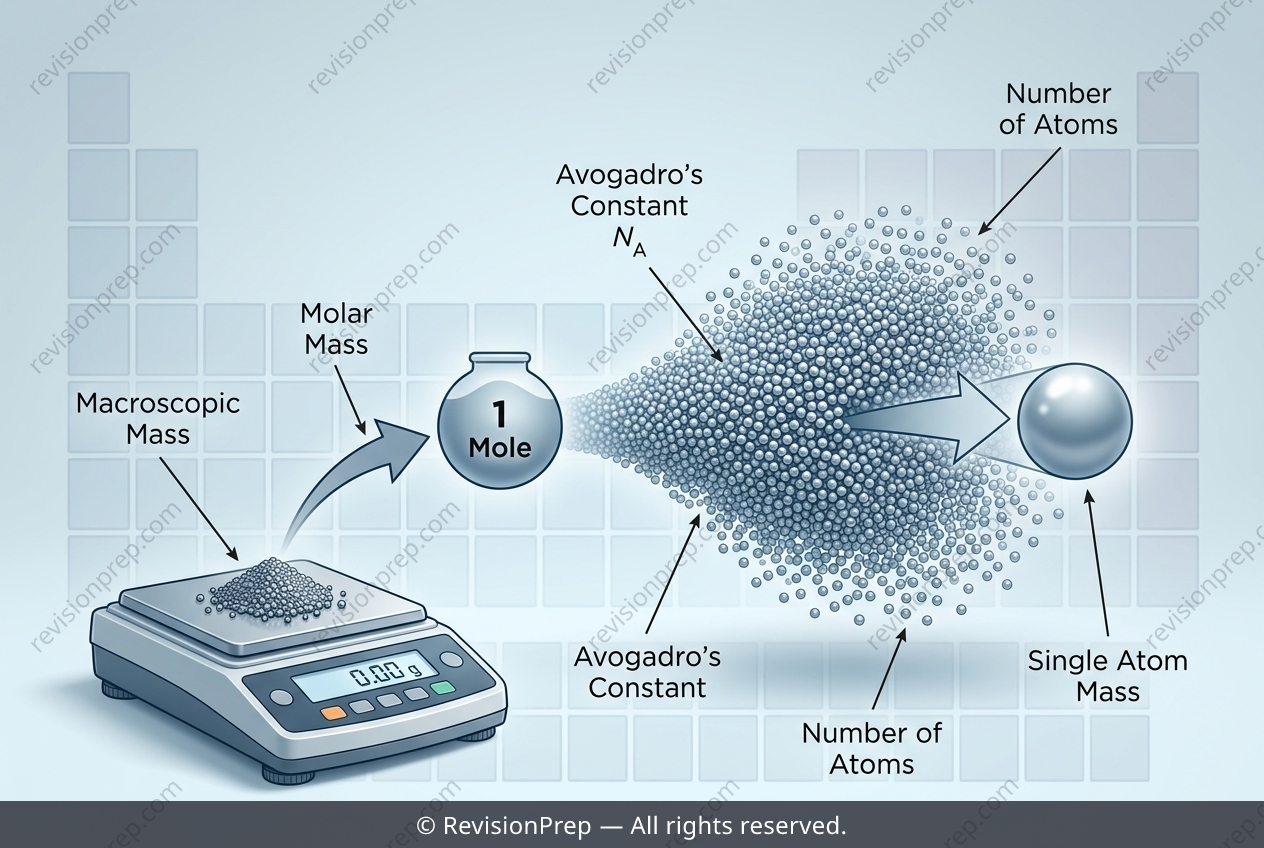
The mole concept is the chemist’s bridge between the invisible world of atoms and the measurable world of grams. At its heart lies molar mass—defined as the mass in grams of exactly one mole of a substance—which for sodium is 23 g mol⁻¹, meaning that 23 grams of sodium contains Avogadro’s constant (6.022 × 10²³) of atoms. This single number, Nₐ, is the conversion factor that turns a macroscopic mass into a precise count of particles. Why does this matter? Because atoms are far too small to weigh individually, yet their collective behaviour—reactions, stoichiometry, and yields—depends on exact numbers. The power of the mole emerges when you connect its two pillars: molar mass (M) tells you the mass of one mole, while Avogadro’s constant tells you how many particles are in that mole. Dividing M by Nₐ isolates the mass of a single atom, revealing a staggering scale: one sodium atom weighs on the order of 10⁻²³ grams, utterly beyond any laboratory balance. This is why the mole is not just a convenience—it is the indispensable counting unit that makes chemistry quantitative, linking the tangible to the atomic.
Start practising IB questions today
150,000+ IB-styled questions, criteria-mapped and instantly accessible.