
Chemistry: When Fertiliser Feeds Turn Toxic
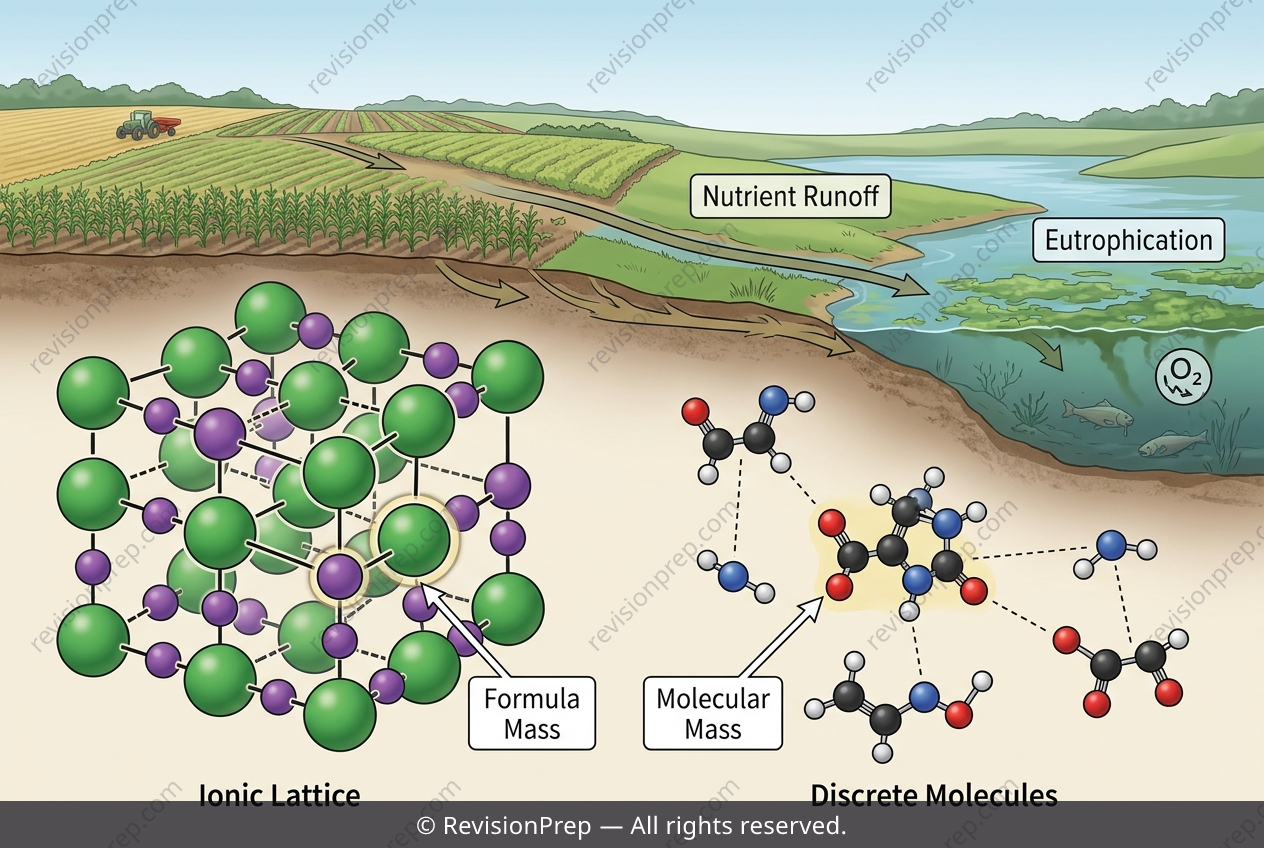
When fertilisers promise greener pastures, the chemistry behind them is anything but simple. At the heart of this topic lies the distinction between formula mass and molecular mass—a difference that hinges on how atoms are bonded and arranged. For ionic compounds like ammonium nitrate (NH₄NO₃), there are no discrete molecules; instead, a giant lattice of alternating ions extends in three dimensions. Because “molecular mass” implies a standalone molecule, it is meaningless here. Instead, chemists use formula mass, which sums the atomic masses of the ions in the simplest ratio—the empirical formula unit—capturing the true nature of the ionic structure. This distinction matters far beyond the lab. The same fertiliser that feeds crops can wreak havoc when over-applied. Nitrogen from NH₄NO₃ or urea (CO(NH₂)₂) can leach as nitrate into waterways, triggering eutrophication: algal blooms that starve aquatic life of oxygen. Alternatively, excess nitrogen may volatilise as nitrous oxide (N₂O), a potent greenhouse gas. Understanding molar mass terminology is not just about naming—it’s the first step toward grasping how chemical structure dictates environmental fate.
Start practising IB questions today
150,000+ IB-styled questions, criteria-mapped and instantly accessible.