
Chemistry: Why Boiling Fails: Nitrates, Pathogens, and Water Treatment Efficacy
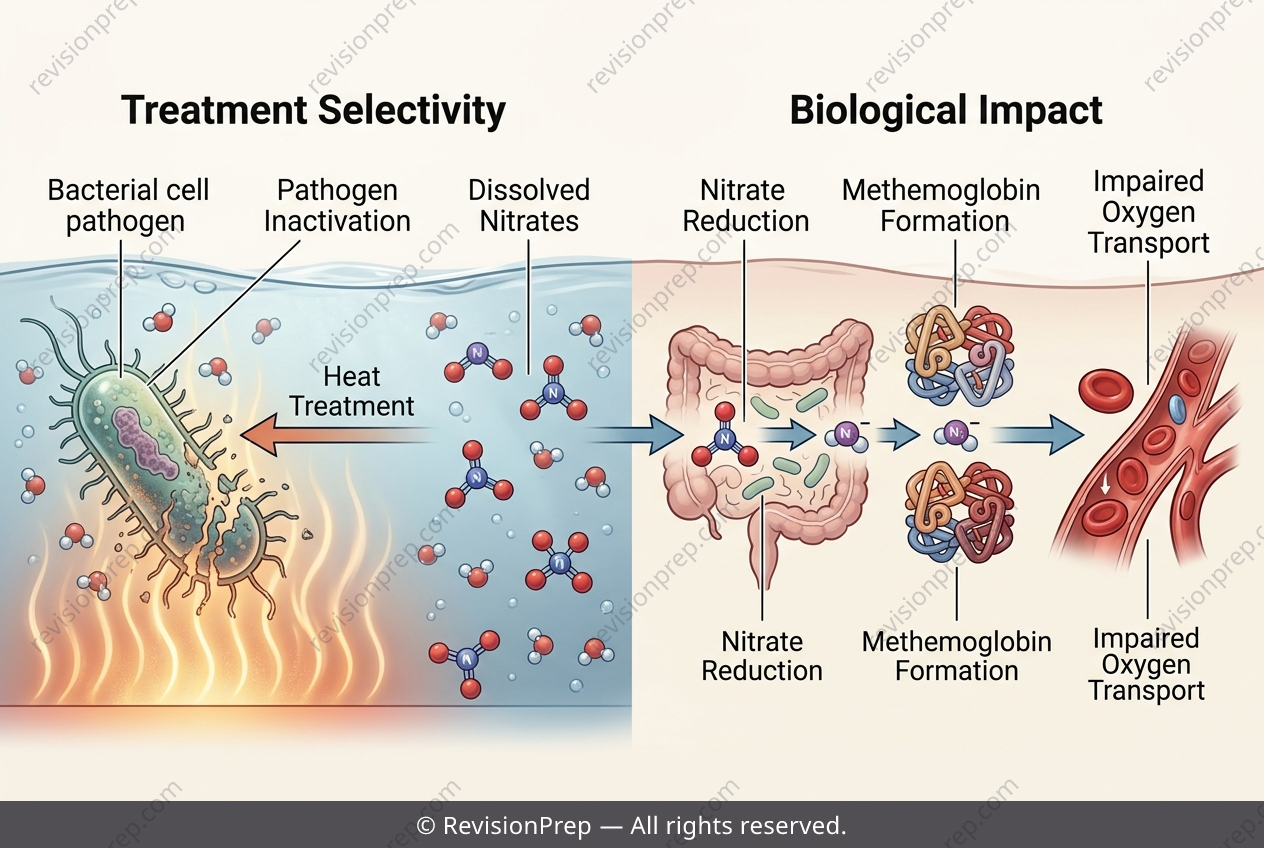
Water treatment is rarely a single-step solution, and the gap between “safe” and “apparently safe” is where chemistry becomes critical. In this scenario, a rural community faces two distinct classes of contamination: visible silt (suspended solids) and invisible dissolved nitrates (NO₃⁻) from fertiliser runoff. The core concept here is differential treatment efficacy—the idea that a method effective against one contaminant type may be completely useless against another, depending on the physical and chemical state of the pollutant. Boiling, for instance, exploits thermal denaturation to kill pathogens by destroying their proteins and cellular structures. Yet nitrates are ionic species that remain fully dissociated in water at 100°C; they neither evaporate, decompose, nor precipitate, so boiling leaves their concentration untouched. This chemical inertness is why biological safety does not equal chemical safety. The danger deepens through biotransformation: in the gut, nitrates are reduced to nitrites (NO₂⁻), which bind haemoglobin to form methaemoglobin—a form unable to carry oxygen. Infants are especially vulnerable because their less acidic stomach pH allows nitrate-reducing bacteria to flourish, producing more nitrite per unit of nitrate. Understanding these mechanisms reveals why a single method like boiling offers only partial protection, and why complementary processes—such as reverse osmosis, which physically removes dissolved ions—are essential for holistic water safety.
Start practising IB questions today
150,000+ IB-styled questions, criteria-mapped and instantly accessible.