
Chemistry: Why 'Greener' Depends on the Unit
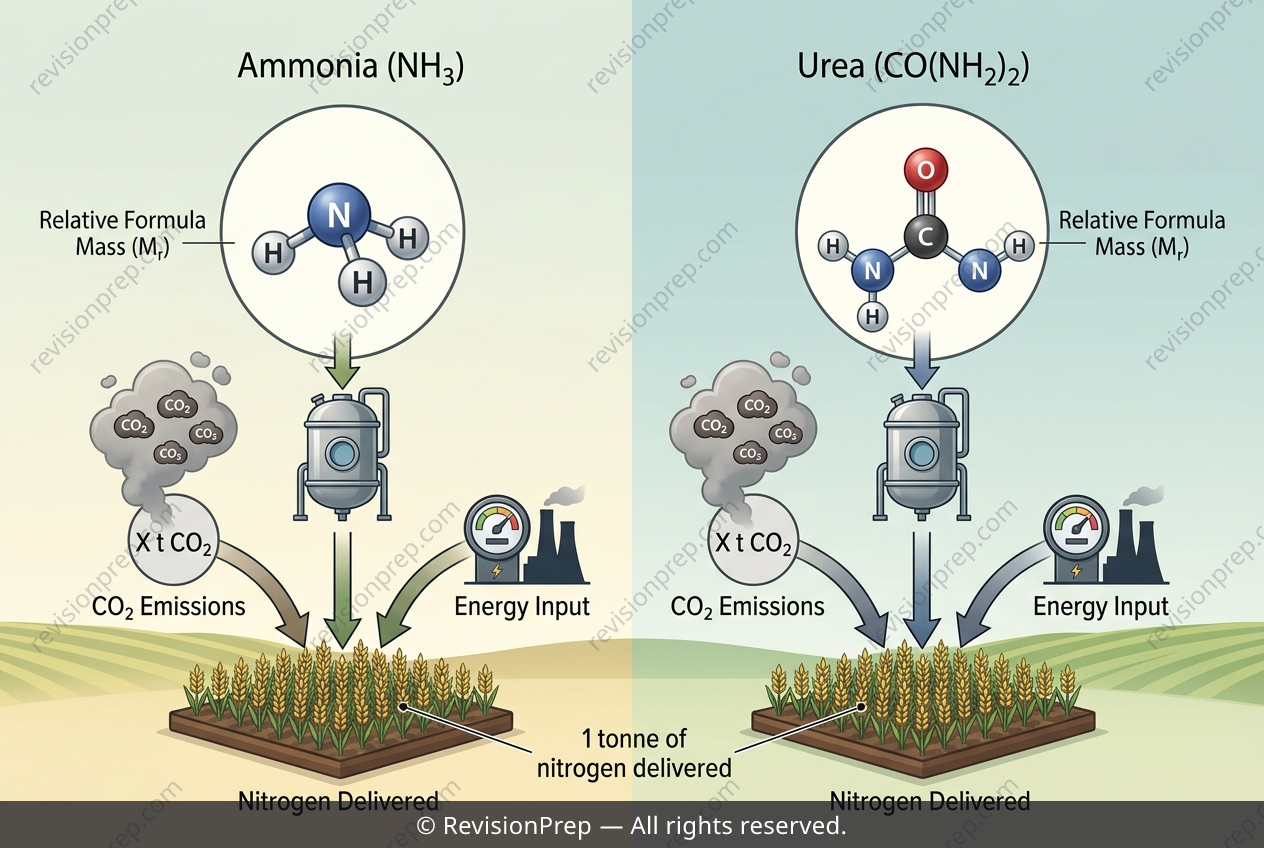
Choosing the right nitrogen fertilizer isn’t just about which bag is cheaper—it’s about how efficiently each product delivers its core function: getting nitrogen to crops. This is where comparative environmental impact assessment comes in. Instead of comparing emissions per tonne of product, we must normalise everything to a single functional unit—here, one tonne of actual nitrogen delivered to the field. The key relationship is simple: mass of fertilizer needed = 1 ÷ (fraction of nitrogen in the product). Because ammonia is 82.3% nitrogen by mass while urea is only 46.7%, you need far more urea to supply the same nitrogen dose. This shift in perspective changes the entire sustainability picture. Although urea produces less CO₂ per tonne of product (1.5 t vs 1.9 t) and uses less energy (22 GJ vs 28 GJ), its lower nitrogen density means those advantages are diluted. When you scale emissions by the mass required to deliver one tonne of nitrogen, the comparison flips. The relative formula mass (Mᵣ) alone—17.0 for NH₃ versus 60.1 for urea—tells you nothing about production energy, greenhouse gas intensity, or practical handling (ammonia needs pressurised storage; urea is a safe solid). A meaningful verdict requires linking nitrogen content, product emissions, and delivery mass into one integrated calculation, revealing that the “greener” product depends entirely on the unit of comparison you choose.
Start practising IB questions today
150,000+ IB-styled questions, criteria-mapped and instantly accessible.