
Chemistry: Calculate Kc, Then Apply Le Chatelier
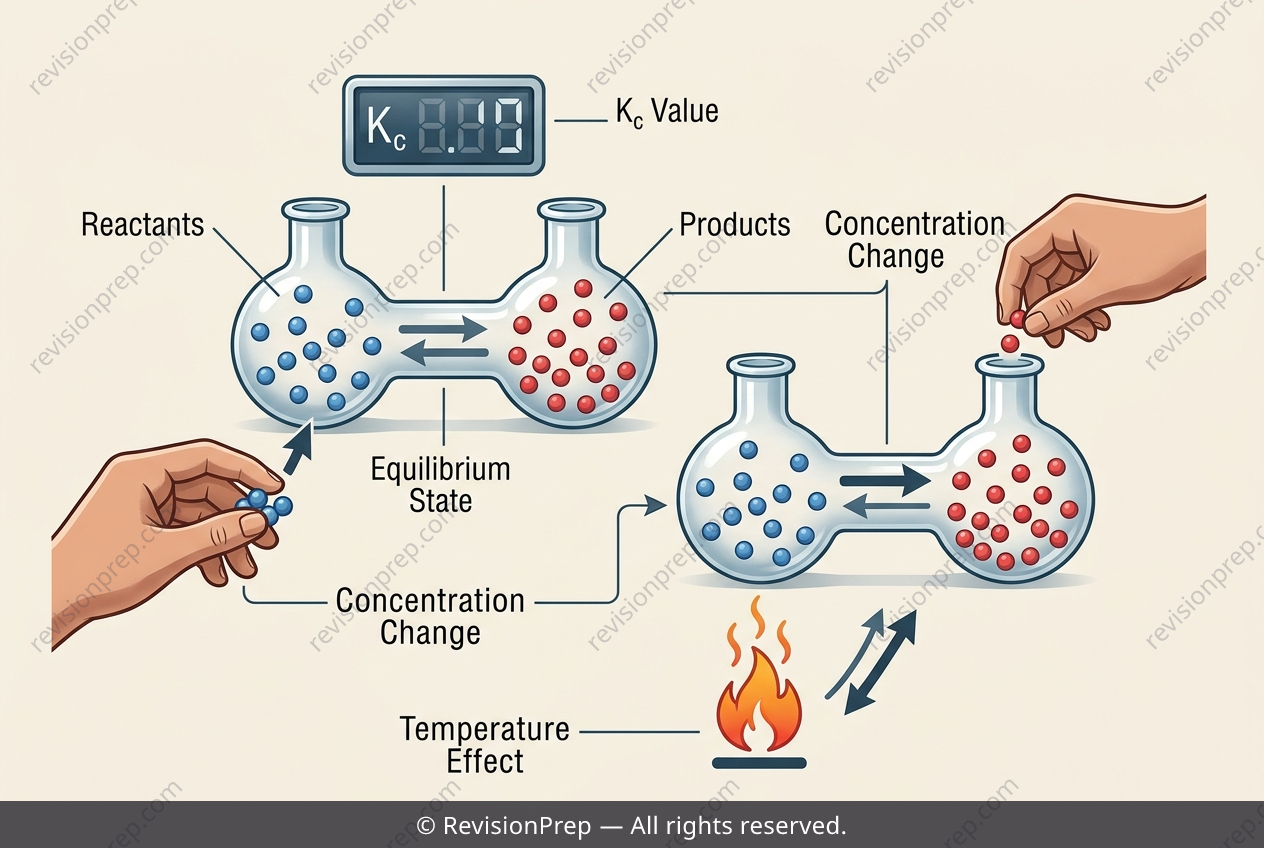
Chemical equilibrium is the delicate balancing act that occurs when a reversible reaction settles into a state where the forward and reverse rates are equal, leaving the concentrations of reactants and products constant over time. For IB Chemistry SL students, this concept is central to understanding why reactions like esterification—where ethanoic acid and ethanol form ethyl ethanoate and water—do not simply run to completion. Instead, the system reaches a dynamic balance described by the equilibrium constant, Kc, which is calculated as the ratio of product concentrations to reactant concentrations, each raised to the power of their stoichiometric coefficients. In this case, because the reaction takes place in a 1.00 dm³ flask, the mole amounts directly equal molar concentrations, making the ICE table (Initial, Change, Equilibrium) a straightforward tool for finding the equilibrium concentrations from the known amount of ester produced. The power of this concept lies in Le Chatelier’s Principle, which predicts how a system at equilibrium responds to disturbances. If you add excess ethanol, the equilibrium shifts to the right, consuming some of the added reactant to produce more ester. Conversely, removing water—a product—also drives the reaction forward, as the system attempts to replace what was lost. Temperature adds another layer: since this esterification is endothermic (ΔH = +2.0 kJ mol⁻¹), increasing the temperature shifts the equilibrium in the forward direction, raising the value of Kc and thus increasing the yield of ethyl ethanoate from equal starting moles. Understanding these relationships connects the quantitative Kc calculation to the qualitative shifts, giving you a complete
Start practising IB questions today
150,000+ IB-styled questions, criteria-mapped and instantly accessible.