
Chemistry: Calculating Ammonia Yield with Kc
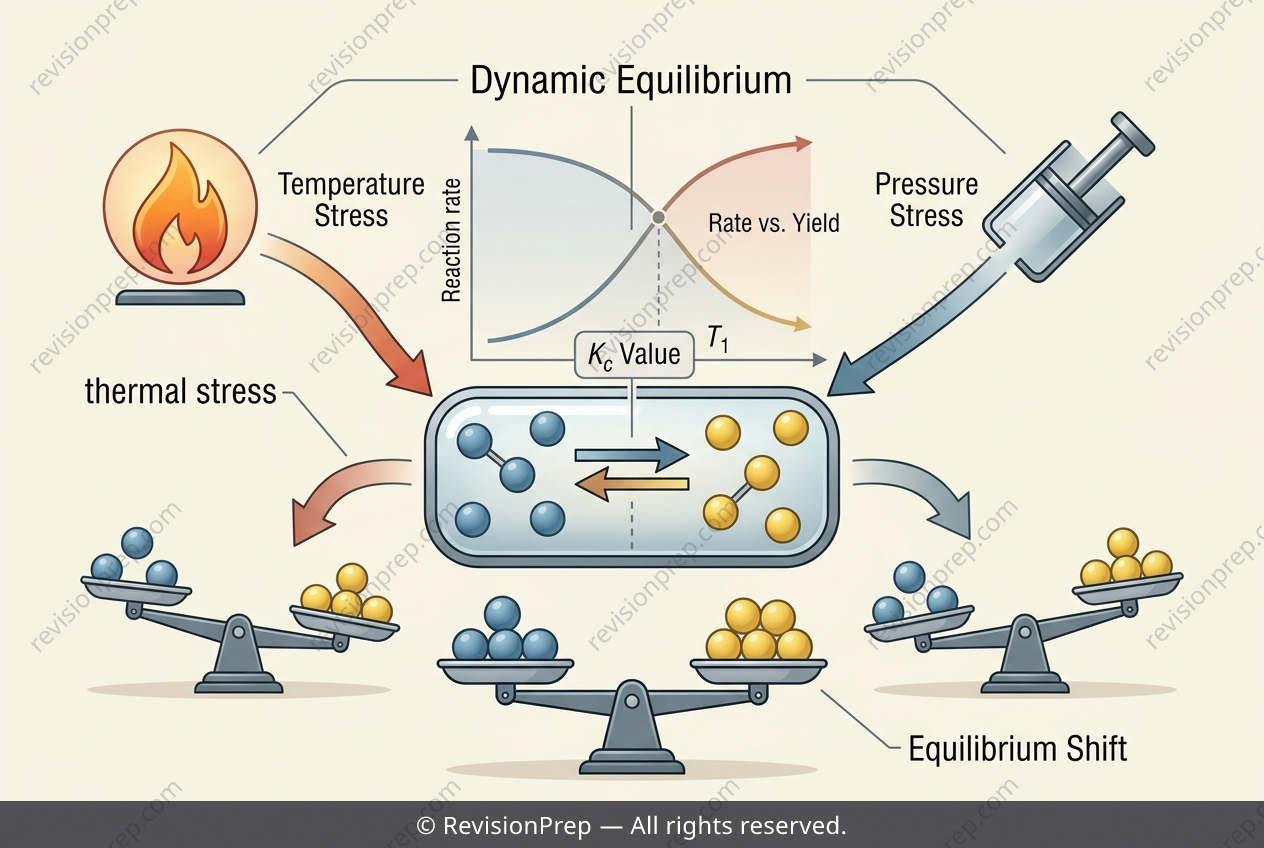
Dynamic chemical equilibrium is the delicate balancing act where the forward and reverse reactions proceed at identical rates, leaving macroscopic concentrations unchanged—yet the system remains intensely active at the molecular level. In the Haber process, N₂ and H₂ combine to form ammonia, but the reverse decomposition never stops; the position of this balance dictates industrial yield. This concept matters because it explains how real-world conditions—temperature, pressure, and concentration—can be manipulated to favour a desired product, transforming a theoretical equation into a practical tool for producing fertilisers and chemicals. The equilibrium constant, Kc, quantifies this balance: Kc = [NH₃]² / ([N₂][H₂]³). Using an ICE table (Initial, Change, Equilibrium) reveals how stoichiometric ratios link the consumption of reactants to the formation of products. For this exothermic reaction (ΔH negative), Le Chatelier’s principle predicts that lower temperatures shift the equilibrium right, boosting yield—but at the cost of a slower rate. Meanwhile, increasing pressure shifts the system toward fewer gas moles (products), as shown by comparing the reaction quotient Q to Kc. These interconnected relationships—thermodynamics, kinetics, and stoichiometry—form the backbone of predicting and controlling chemical reactivity.
Start practising IB questions today
150,000+ IB-styled questions, criteria-mapped and instantly accessible.