
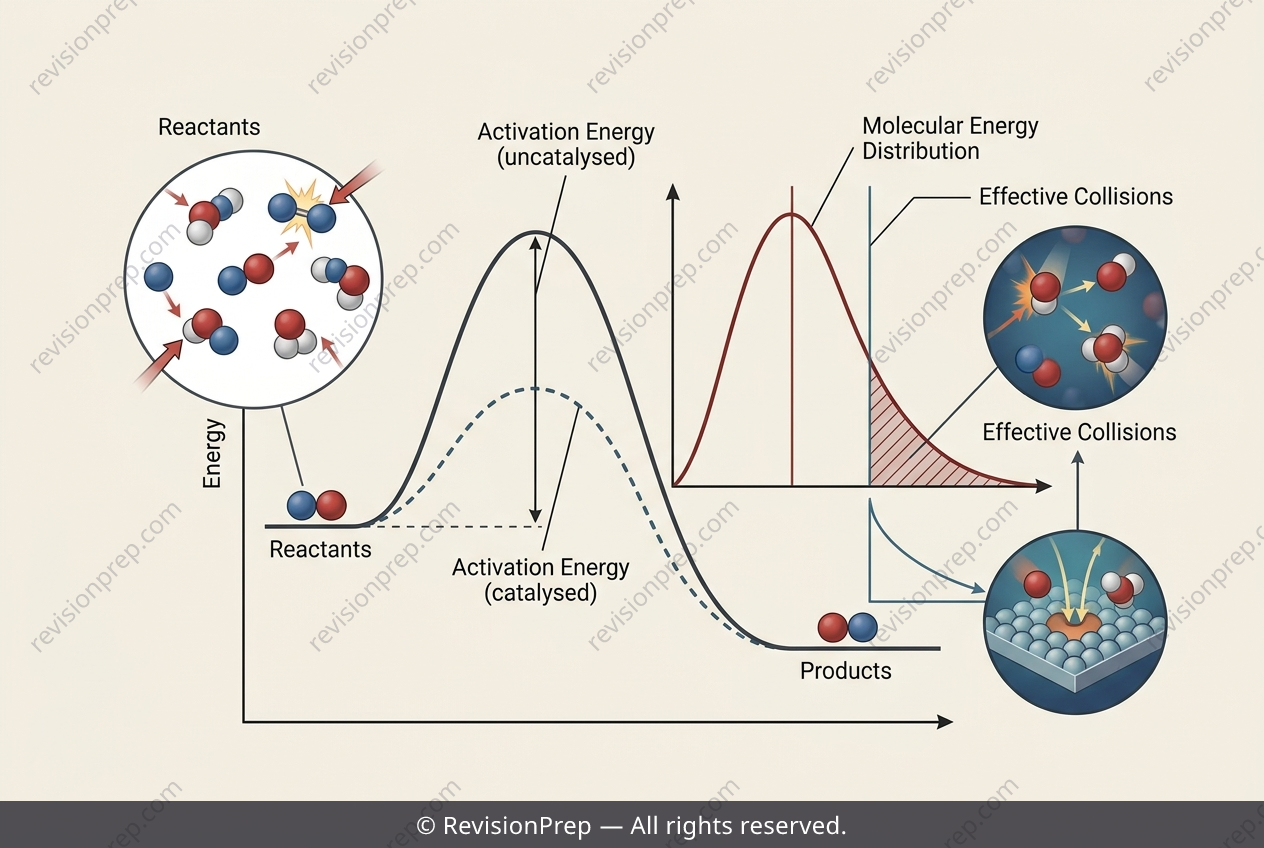
Chemistry: Catalysts Lower Ea — But Never Change ΔH
Activation energy and catalysis sit at the heart of why some reactions—like the Haber process for ammonia—need extreme conditions to proceed at a useful rate. In essence, activation energy (Ea) is the minimum energy colliding molecules must bring to break existing bonds and form new ones; without it, even thermodynamically favourable reactions stall. For nitrogen and hydrogen, the formidable triple bond in N₂ means a very high Ea, which is why industrial synthesis relies on an iron catalyst to provide an alternative, lower-energy pathway. The key relationship here is that the forward and reverse activation energies are linked through the enthalpy change: Ea(reverse) = Ea(forward) − ΔH. For an exothermic forward reaction, the reverse step always has a higher barrier. Catalysts work by reducing Ea for both directions equally, without altering ΔH. This shifts the threshold on a Maxwell–Boltzmann distribution to the left, so a far greater proportion of molecules possess energy above the new Ea. More successful collisions per second translate directly into a faster rate—while the equilibrium position remains untouched.
Start practising IB questions today
150,000+ IB-styled questions, criteria-mapped and instantly accessible.