
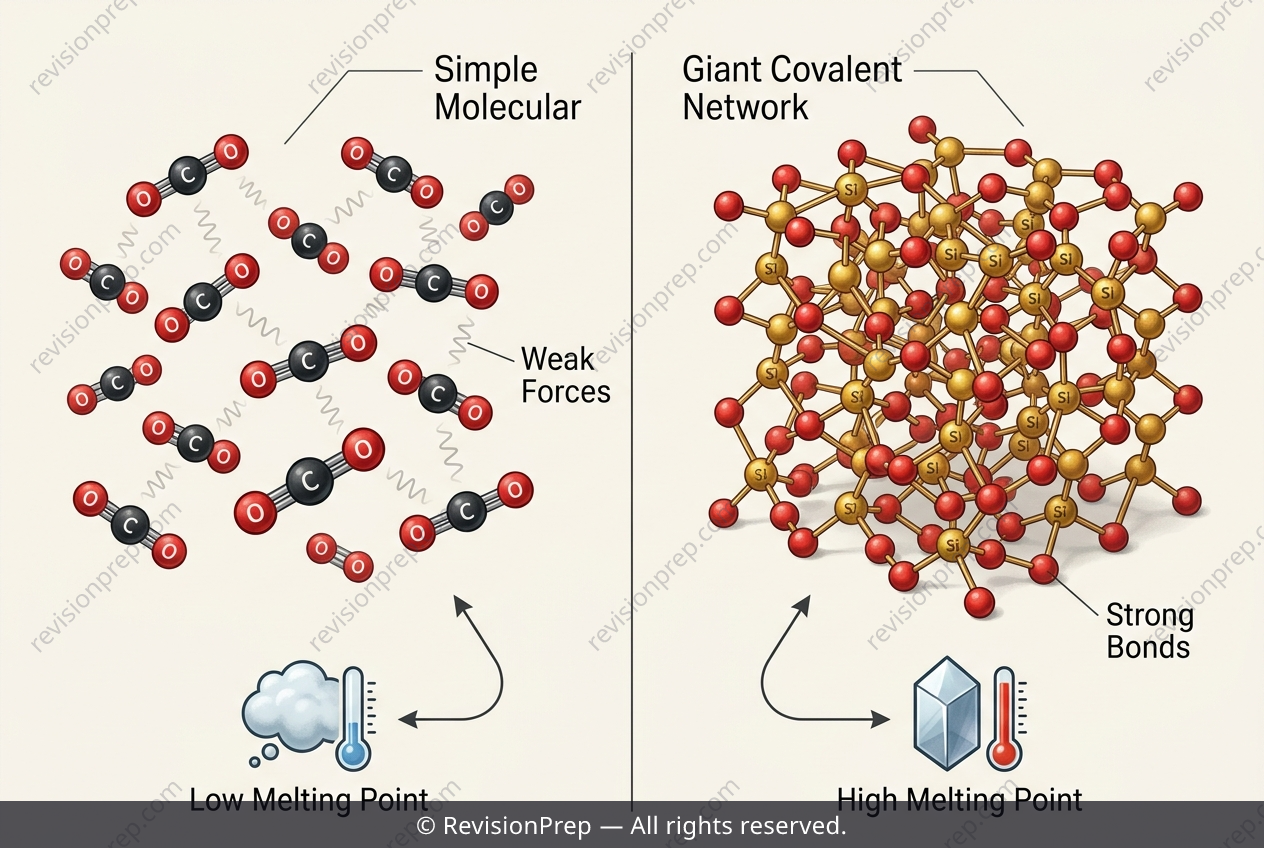
Chemistry: CO₂ vs SiO₂ - Structure Changes Everything
Why does carbon dioxide—a gas you exhale—share an empirical formula with quartz, one of the hardest minerals on Earth? The answer lies not in the atoms themselves, but in how they bond and arrange. This topic explores the bridge between microscopic structure and macroscopic properties: specifically, why simple molecular substances with strong covalent bonds (like CO₂) remain gases, while giant covalent lattices (like SiO₂) form rigid, high-melting solids. The key distinction is structural, not just bond strength. In CO₂, carbon forms two double bonds with oxygen, creating a linear, non-polar molecule (bond dipoles cancel perfectly). These discrete molecules interact only through weak London forces, so little energy is needed to separate them. In SiO₂, each silicon bonds to four oxygens in a continuous 3D network—breaking it requires overcoming countless covalent bonds. Even though the Si–O bond is more polar than C=O (electronegativity difference 1.54 vs. 0.89), polarity is secondary to architecture. Bond enthalpy calculations, using average values, help quantify the energy trade-offs, but the real lesson is that molecular shape and connectivity dictate state and melting point far more than individual bond strength.
Start practising IB questions today
150,000+ IB-styled questions, criteria-mapped and instantly accessible.