
Maths: When Interest Meets Differential Equations
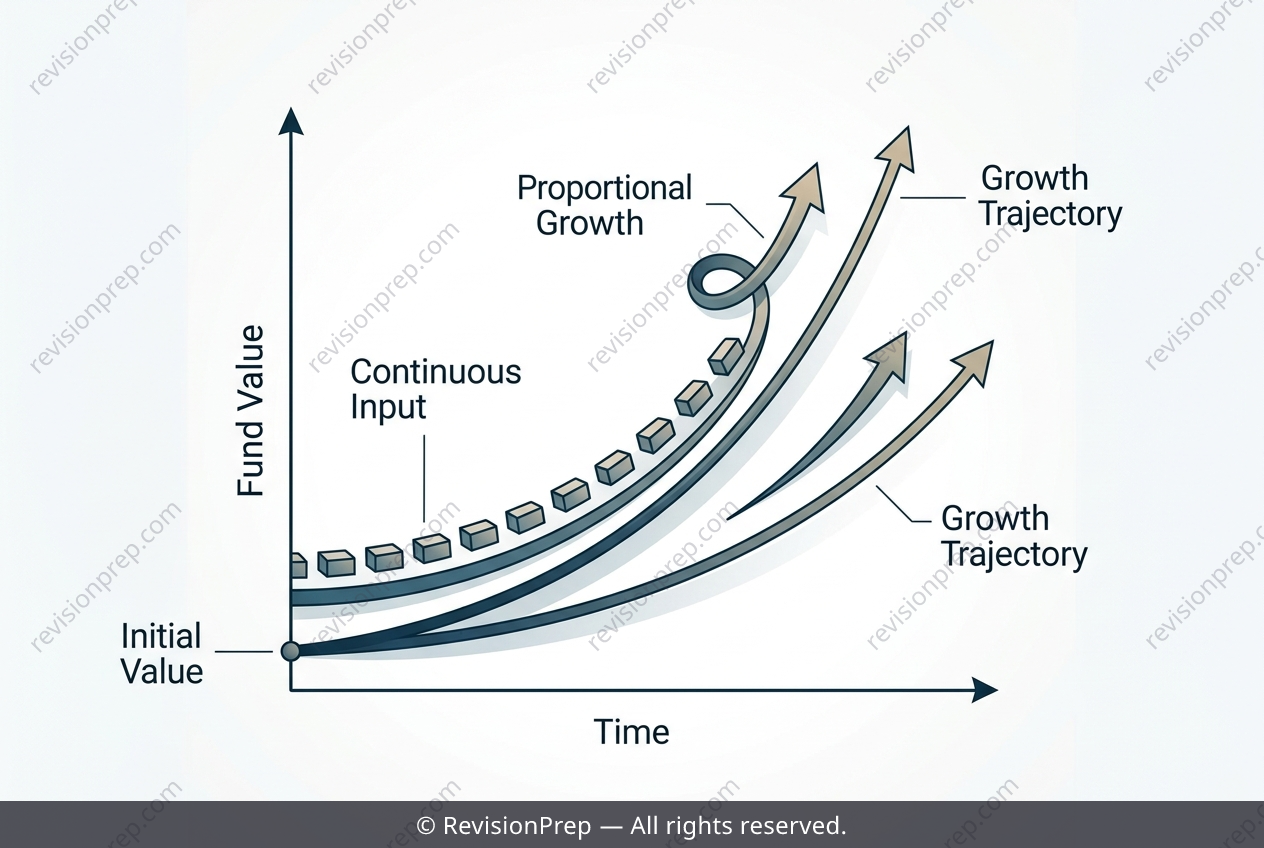
Differential equations let us describe how quantities change moment by moment—and, crucially, predict their future values. In this Maths AA SL Calculus topic, we focus on first-order linear differential equations of the form dV/dt = kV + C, which appear everywhere from population growth to cooling objects to, as here, an investment fund that earns interest while receiving a constant annual deposit. The key move is to rewrite the equation so the left side becomes the derivative of a product. Multiplying through by an integrating factor, here e^(−0.05t), collapses the expression into d/dt(V·e^(−0.05t)) = 2000e^(−0.05t). Integrating both sides then reveals the general solution V(t) = Ae^(0.05t) − 40000, where the constant A is fixed by the initial condition V(0) = 10000. This structure separates the natural exponential growth (the 5% interest) from the steady inflow of 2000 per year, which shifts the equilibrium downward by 40000. Understanding how these two forces combine—and how removing the deposit changes the time to reach a target—shows why modelling dynamic systems matters: small changes in the equation can dramatically alter long-term outcomes.
Start practising IB questions today
150,000+ IB-styled questions, criteria-mapped and instantly accessible.