
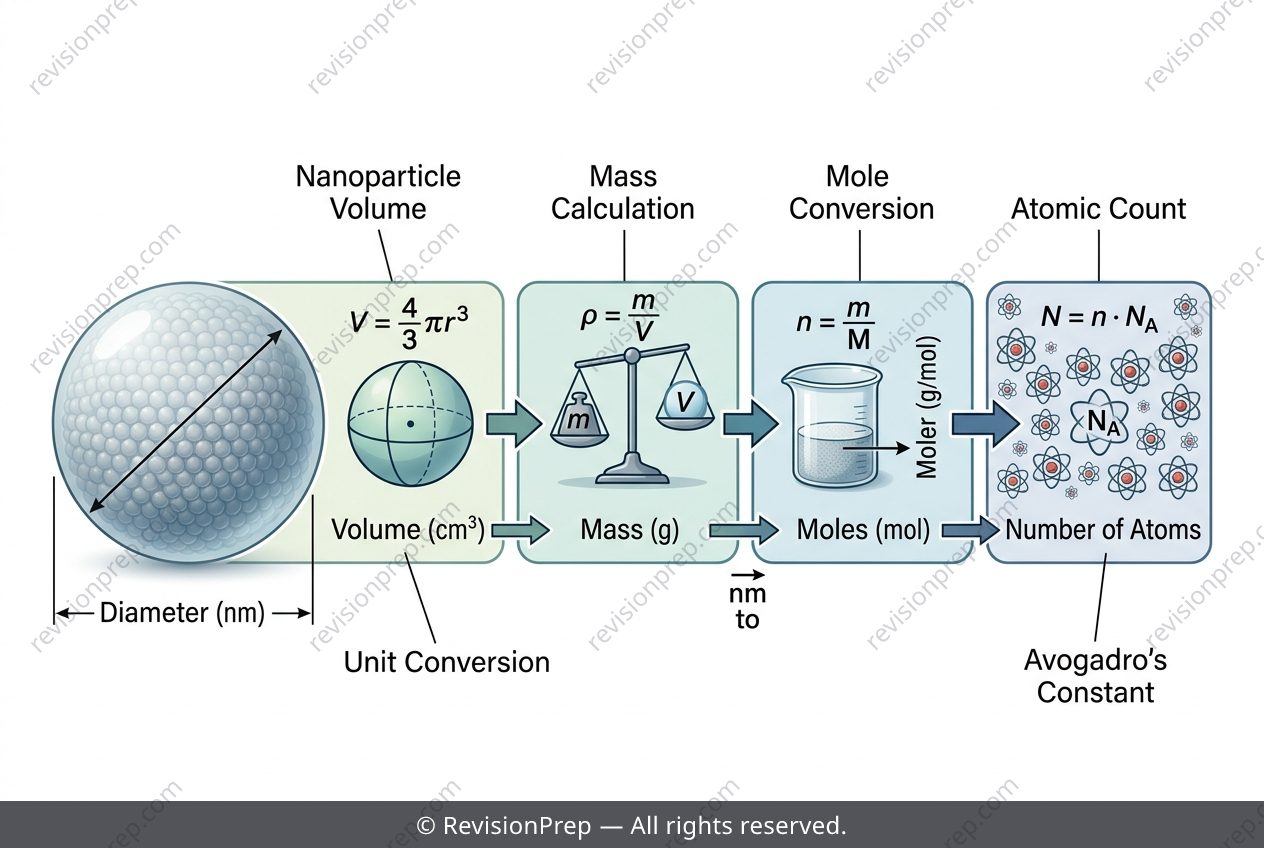
Chemistry: Counting Atoms in a Single Nanoparticle
Nanoscale matter sits at the fascinating intersection of chemistry and physics, where the familiar bulk properties of elements give way to size-dependent behaviour. When we shrink a material down to a nanoparticle—just a few tens of nanometres across—we are no longer dealing with an infinite lattice, but with a finite cluster of atoms whose number can be precisely calculated. This is the heart of quantitative nanoscale analysis: connecting a measurable physical dimension to the discrete atomic count that defines the particle’s identity. The key relationship here links geometry, density, and molar mass. For a spherical nanoparticle, its volume is determined by the radius using the formula for a sphere’s volume (V = 4/3 πr³). Once the volume is known, multiplying by the material’s density gives the particle’s mass. That mass, when divided by the molar mass and multiplied by Avogadro’s constant, reveals how many atoms are packed inside. Each step is a unit conversion—from nanometres to centimetres, from volume to mass, and finally from moles to individual atoms—demonstrating how macroscopic constants like density and Avogadro’s number bridge the gap to the atomic world. Understanding this chain of reasoning is essential for interpreting the properties of nanomaterials, from catalysis to drug delivery, where atom count directly influences reactivity and function.
Start practising IB questions today
150,000+ IB-styled questions, criteria-mapped and instantly accessible.