
Chemistry: Cracking Manganese’s Oxidation Code
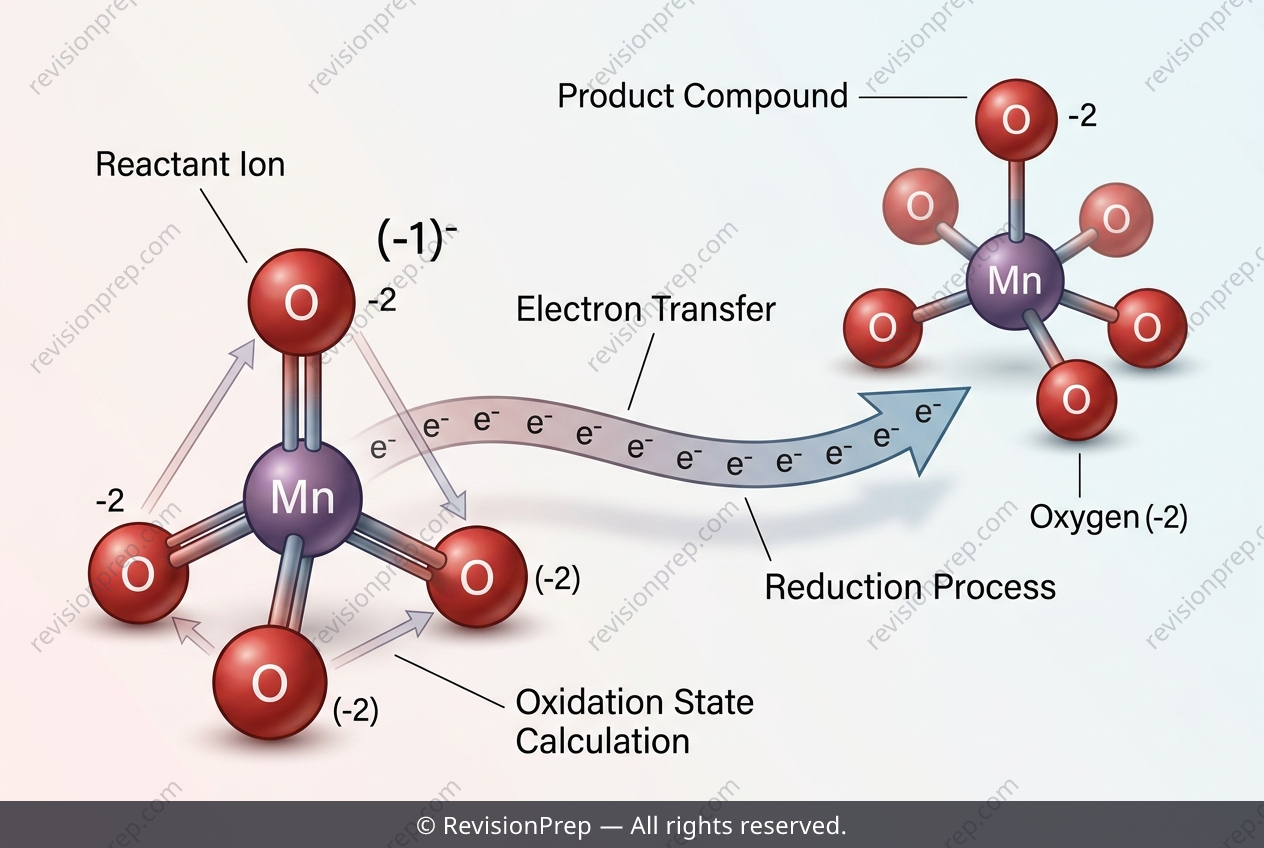
Oxidation states are the bookkeeping system chemists use to track electrons in compounds and ions. They assign a hypothetical charge to each atom, assuming that all shared electrons in a bond are given to the more electronegative element. This simple tool transforms a messy list of formulas into a predictive framework, allowing you to compare the redox behaviour of different species at a glance. The concept matters because it reveals which species can act as an oxidising agent, a reducing agent, or both. For a central atom like manganese, which can adopt many oxidation states, the value determines its reactivity and the colour of its compounds. To find the state, you apply a set of rules: the sum of oxidation states in a neutral compound equals zero, while for a polyatomic ion it equals the ion’s charge. Oxygen is almost always –2, and hydrogen is usually +1. By setting up a simple algebraic equation—for example, in a neutral oxide where x + 2(–2) = 0—you can solve for the unknown oxidation state of the metal. This logic connects the formula of a species directly to its electron distribution, making it possible to identify which manganese-containing product corresponds to a +4 state without memorising every compound.
Start practising IB questions today
150,000+ IB-styled questions, criteria-mapped and instantly accessible.