
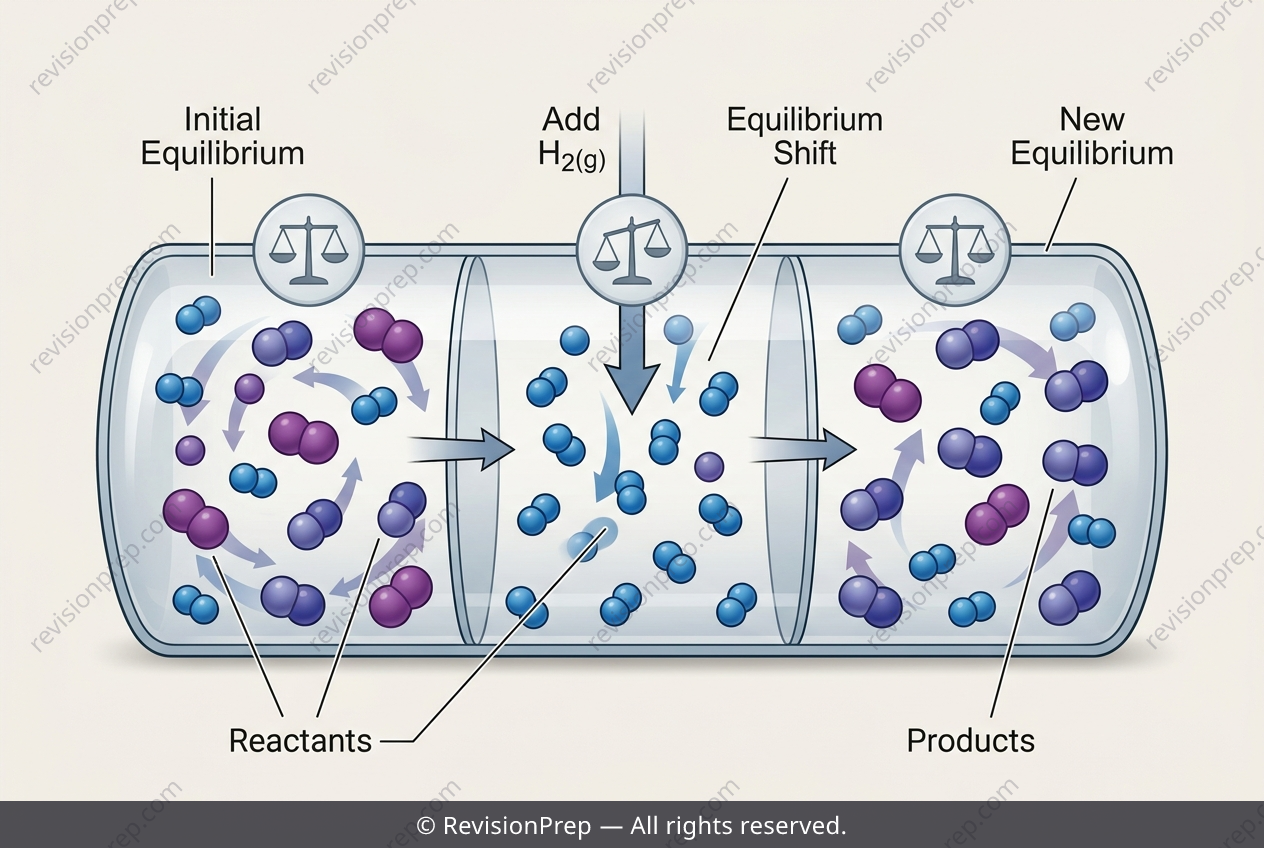
Chemistry: H₂ + I₂ ⇌ 2HI — Predicting the Shift
Le Chatelier’s Principle is the compass chemists use to predict how a system at equilibrium responds to disturbance. In essence, it states that if a dynamic equilibrium is subjected to a change in concentration, pressure, or temperature, the system will shift its position to partially counteract that change, re-establishing a new equilibrium state. For the reaction H₂(g) + I₂(g) ⇌ 2HI(g), this principle explains why injecting extra H₂ into a sealed, constant-temperature container doesn’t simply leave the other concentrations untouched—it triggers a cascade of adjustments. The key relationship here is the balance between reactants and products. Adding H₂ increases its concentration, so the system “fights back” by consuming some of that added H₂, which simultaneously draws down I₂ and generates more HI. This shift to the right is not about kinetics (how fast) but about thermodynamics (how far). The equilibrium constant, Kc = [HI]²/([H₂][I₂]), remains fixed at constant temperature, so the system must adjust concentrations to keep this ratio satisfied. Thus, the immediate effect is a decrease in [I₂] and an increase in [HI], while [H₂] settles at a value higher than its original but lower than its post-injection spike. Understanding this predictive logic is fundamental for mastering reactivity, as it applies to industrial processes like the Haber process and to acid–base equilibria alike.
Start practising IB questions today
150,000+ IB-styled questions, criteria-mapped and instantly accessible.