
Chemistry: Hess's Law - Revealing SF₆ Bond Strength
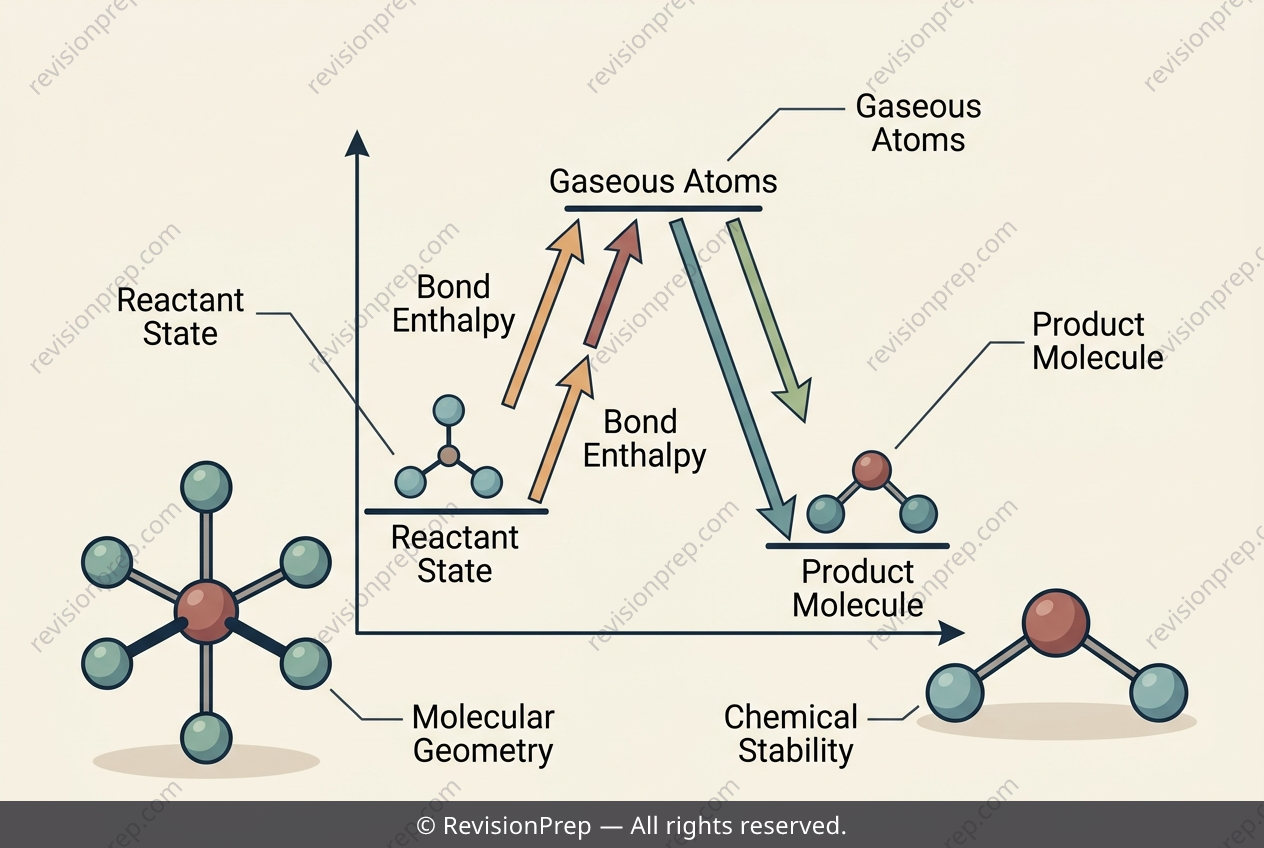
Thermochemical cycles are a powerful way to visualise energy changes that cannot be measured directly, such as the formation of a complex molecule from its elements. By breaking a reaction into a series of known steps—atomisation, bond breaking, and bond forming—you can use Hess’s law to link these enthalpy changes and reveal the stability of a compound. This matters because a molecule’s reactivity is not just about which bonds exist, but about how much energy is locked into those bonds and how that energy is distributed across its structure. For sulfur hexafluoride, SF₆, the cycle connects the enthalpy of atomisation of solid sulfur, the bond dissociation enthalpy of fluorine gas, and the overall enthalpy of formation. Summing the energy input for atomisation and bond breaking, then subtracting the formation enthalpy, gives the total energy released when six S–F bonds form. Dividing by six yields the average bond enthalpy. This value, however, is an average—real bond strengths vary with molecular environment. Crucially, SF₆’s octahedral geometry, with no lone pairs and perfectly symmetric bond dipoles, explains its exceptional inertness compared to bent, polar water, where lone pairs leave the oxygen atom exposed to attack.
Start practising IB questions today
150,000+ IB-styled questions, criteria-mapped and instantly accessible.