
Chemistry: How Arrhenius Links Temperature to Rate
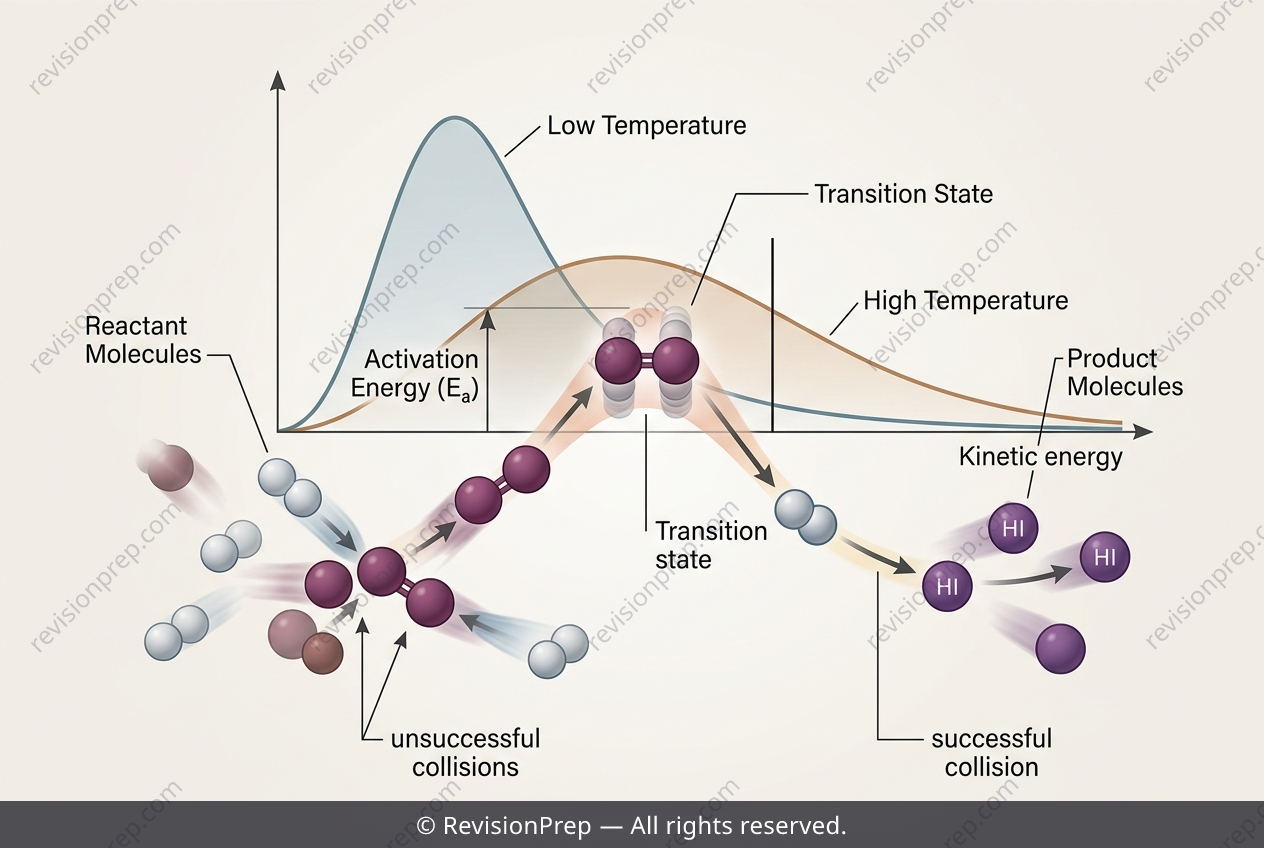
Chemical kinetics answers a deceptively simple question: how fast does a reaction proceed, and what controls that speed? For the bimolecular reaction between hydrogen and iodine gases forming hydrogen iodide, the rate is governed by the collision theory—reactant particles must collide with sufficient energy and correct orientation. The Arrhenius equation, k = Ae^(−Ea/RT), quantifies this, showing that the rate constant depends exponentially on the activation energy (Ea) and temperature (T). Here, the forward activation energy is 167 kJ mol⁻¹, and since the reaction is endothermic (ΔH = +9.4 kJ mol⁻¹), the reverse activation energy is simply the forward value minus ΔH—a direct consequence of energy conservation along the reaction coordinate. Why does this matter? Because the exponential term e^(−Ea/RT) reveals a dramatic sensitivity: at room temperature, the fraction of collisions with enough energy is vanishingly small, but at 700 K it becomes many orders of magnitude larger, overwhelming any modest increase in collision frequency. This explains why many reactions are impractical at ambient conditions yet proceed readily when heated. The same framework lets you calculate the rate constant from a pre-exponential factor, and to appreciate that even at high temperatures, only a tiny fraction of collisions are productive—most are simply too weak to overcome the energy barrier.
Start practising IB questions today
150,000+ IB-styled questions, criteria-mapped and instantly accessible.