
Chemistry: How Atomic Mismatch Shapes Duralumin
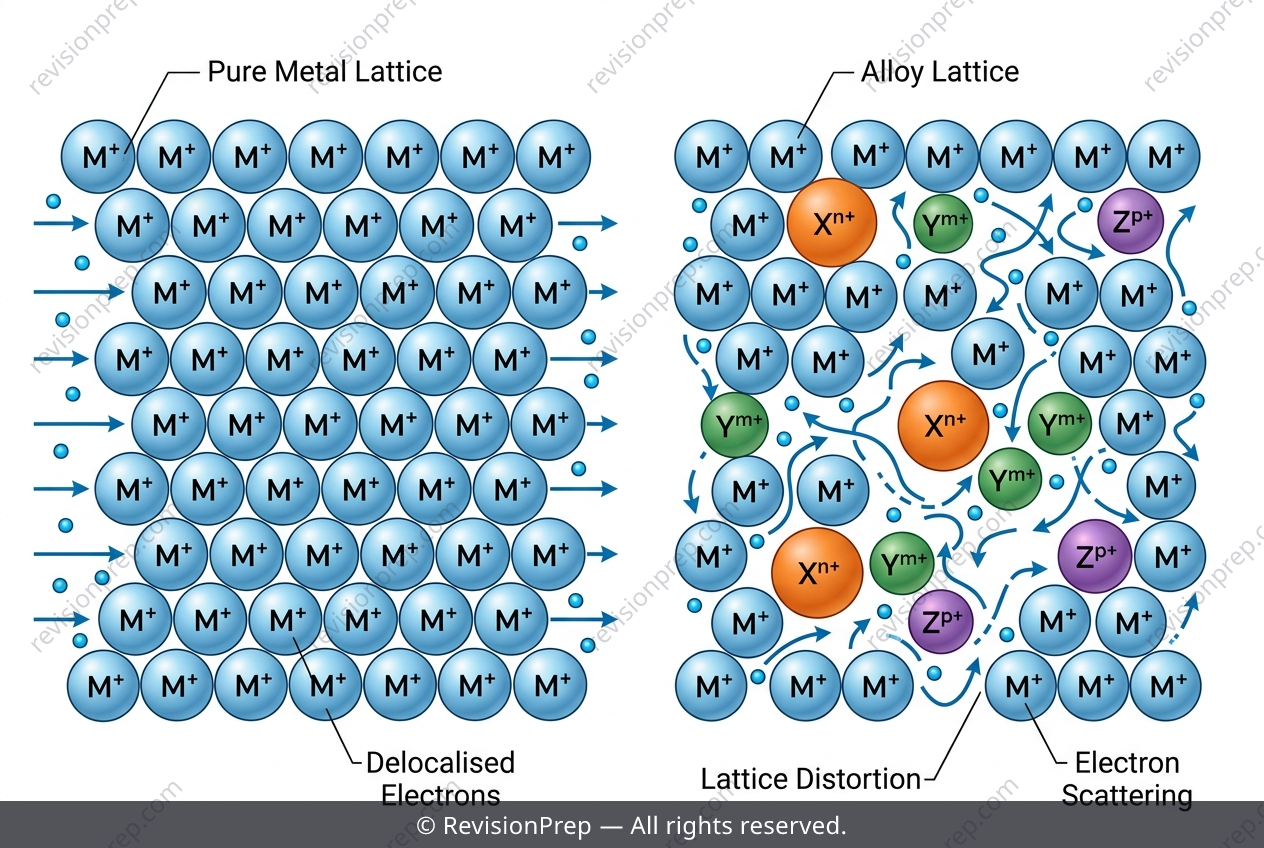
Metallic bonding explains how a lattice of positive ions is held together by a sea of delocalised electrons, giving metals their characteristic conductivity, malleability, and strength. But real-world materials rarely use pure metals—they use alloys, where the deliberate introduction of foreign atoms reshapes these properties in surprising ways. The case of Duralumin, an aerospace alloy of aluminium with copper, magnesium, and manganese, illustrates this beautifully: it is mechanically stronger than pure aluminium, yet its electrical resistivity rises by only about 30%, while its melting point actually drops by roughly 160 K. The key lies in atomic size mismatch. Copper (128 pm), magnesium (160 pm), and manganese (127 pm) all differ from aluminium’s 143 pm, distorting the regular crystal lattice. This distortion disrupts the periodicity of positive ion cores, scattering delocalised electrons more frequently—hence higher resistivity. Simultaneously, the non-uniform charge distribution and local strain weaken the overall electrostatic attraction between the electron sea and cations, reducing the cohesive energy needed to break the lattice apart, which explains the lower melting point. Understanding this trade-off between strength, conductivity, and thermal stability is central to engineering materials for demanding environments.
Start practising IB questions today
150,000+ IB-styled questions, criteria-mapped and instantly accessible.