
Chemistry: How Crystal Structure Affects Metal Conductivity
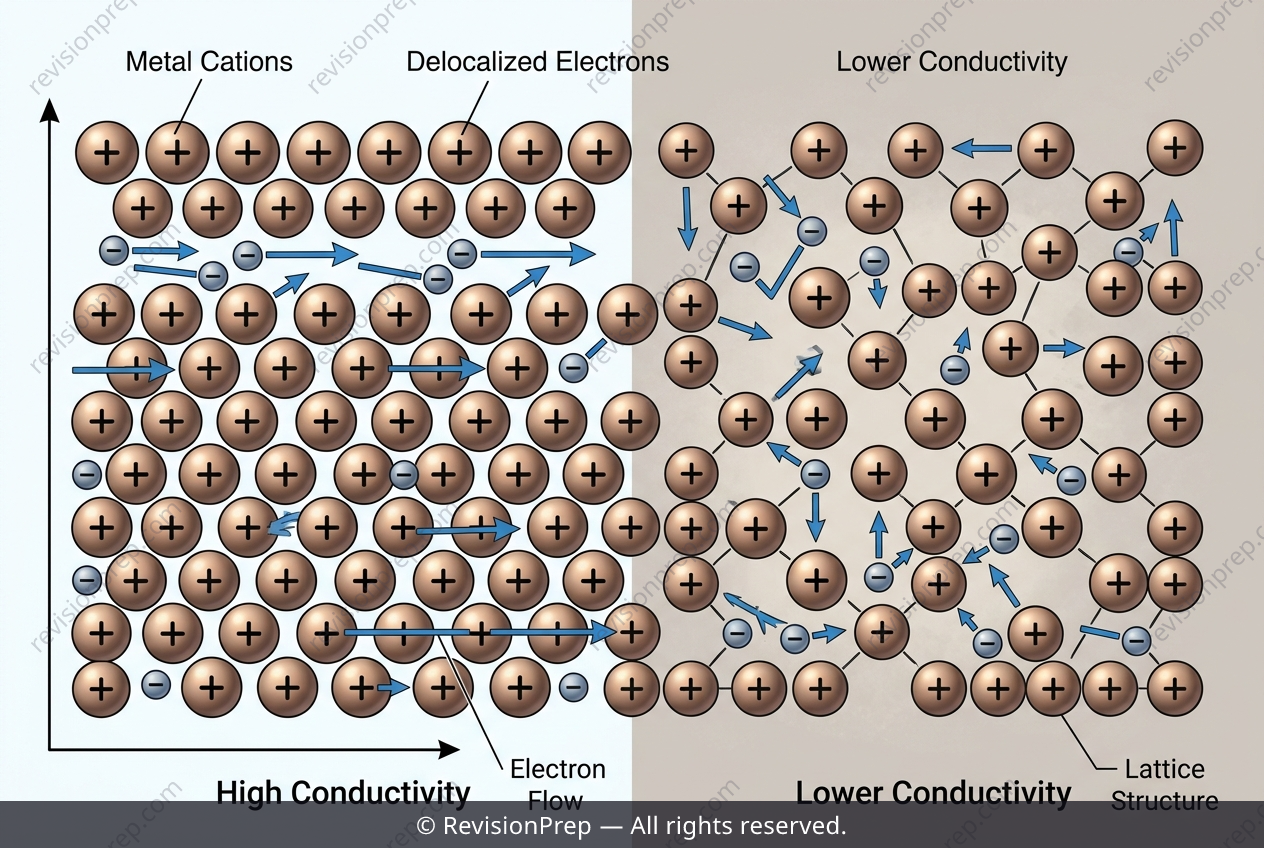
Metals conduct electricity because their atoms release valence electrons into a shared, mobile “sea” that drifts under an applied voltage. In the electron sea model, conductivity (σ) depends on two factors: the number of charge carriers per unit volume and how easily those carriers move—quantified by their mobility or mean free path. Copper and iron both have delocalized electrons, yet their conductivities differ by nearly a factor of six at room temperature, which tells us that carrier density alone cannot explain the gap. The key lies in the crystal structure. Copper adopts a face-centered cubic (FCC) lattice, while iron is body-centered cubic (BCC). In FCC, atoms are packed more tightly and symmetrically, so the periodic potential felt by drifting electrons is smoother. This reduces scattering of electrons by lattice vibrations (phonons), allowing them to travel farther between collisions. Higher conductivity in copper therefore reflects lower resistivity due to less electron-phonon scattering, not stronger bonds or more electrons per atom. The electron sea model thus connects macroscopic conductivity to microscopic lattice regularity and thermal vibration.
Start practising IB questions today
150,000+ IB-styled questions, criteria-mapped and instantly accessible.