
Chemistry: How Electron Transfer Builds Ionic Lattices
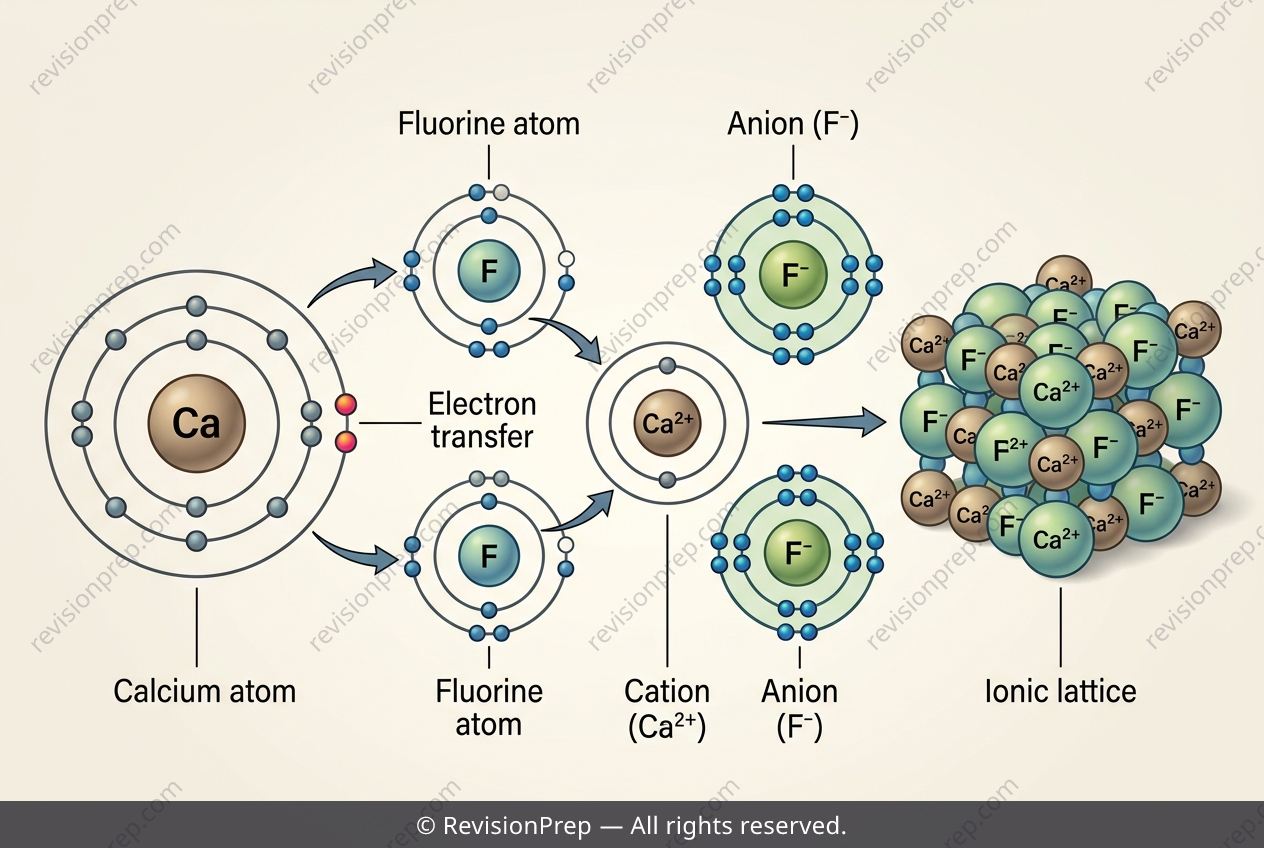
Ionic bonding is the electrostatic force of attraction between oppositely charged ions, formed when electrons are transferred from a metal to a non-metal. In calcium fluoride, this transfer is driven by each atom’s drive to achieve a stable noble-gas electron configuration. Calcium, with electron configuration 2, 8, 2, loses its two outermost electrons to become Ca²⁺. Each fluorine atom (2, 7) gains one electron to complete its octet, forming F⁻. Because one Ca²⁺ ion requires two F⁻ ions to balance charge, the formula unit is CaF₂. In the resulting crystal lattice, every Ca²⁺ ion is surrounded by and electrostatically attracted to multiple F⁻ ions—not just two—creating a giant, repeating three-dimensional structure. This lattice arrangement maximises attractions while minimising repulsions, giving ionic compounds like CaF₂ their characteristic high melting points and brittleness. Understanding this electron transfer and charge-balance relationship is essential for predicting formulas and explaining the physical properties of ionic solids.
Start practising IB questions today
150,000+ IB-styled questions, criteria-mapped and instantly accessible.