
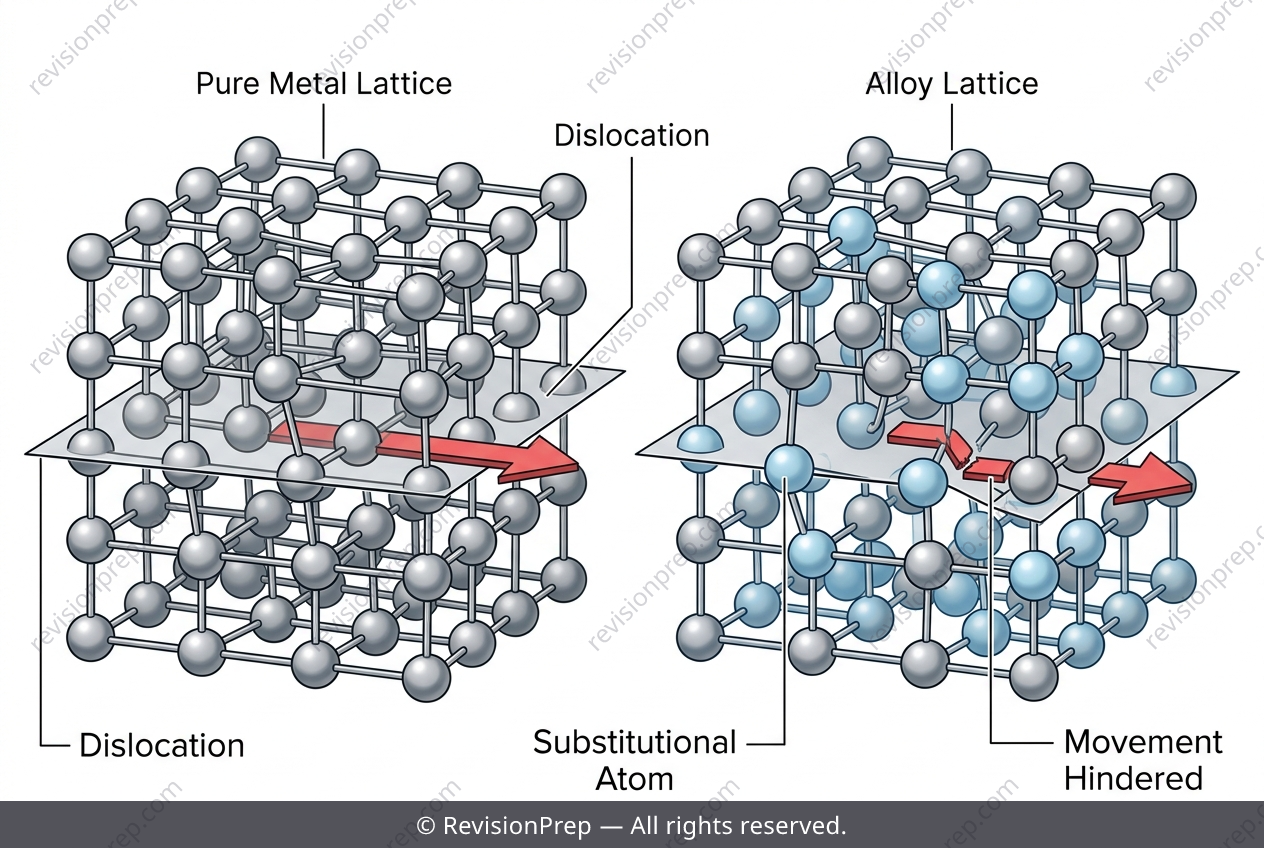
Chemistry: How Lattice Defects Make Alloys Stronger
When a pure metal is bent or hammered, its atoms slide past one another in neat layers—a process called slip. This movement is what makes metals malleable, but it also makes them soft. To strengthen a metal, engineers must find a way to stop those layers from sliding so easily. The answer lies in alloying: deliberately adding foreign atoms to disrupt the perfect order of the crystal lattice. In a substitutional alloy, like the one formed when aluminium is added to nickel, the added atoms are of a similar size to the host metal. Because their radii are close, the aluminium atoms don’t squeeze into the tiny gaps between nickel atoms (which would be an interstitial alloy). Instead, they swap places with nickel atoms in the lattice. This substitution creates local irregularities—tiny disruptions in the otherwise uniform arrangement of atoms. These irregularities act as physical obstacles, or "pins," that hinder the movement of dislocations, which are the line defects responsible for slip. By blocking dislocation motion, the alloy resists deformation, making it significantly harder than the pure metal. The key mechanism is not stronger bonding, but simply a less perfect, more resistant crystal structure.
Start practising IB questions today
150,000+ IB-styled questions, criteria-mapped and instantly accessible.