
Chemistry: How the Electron Sea Powers Conductivity
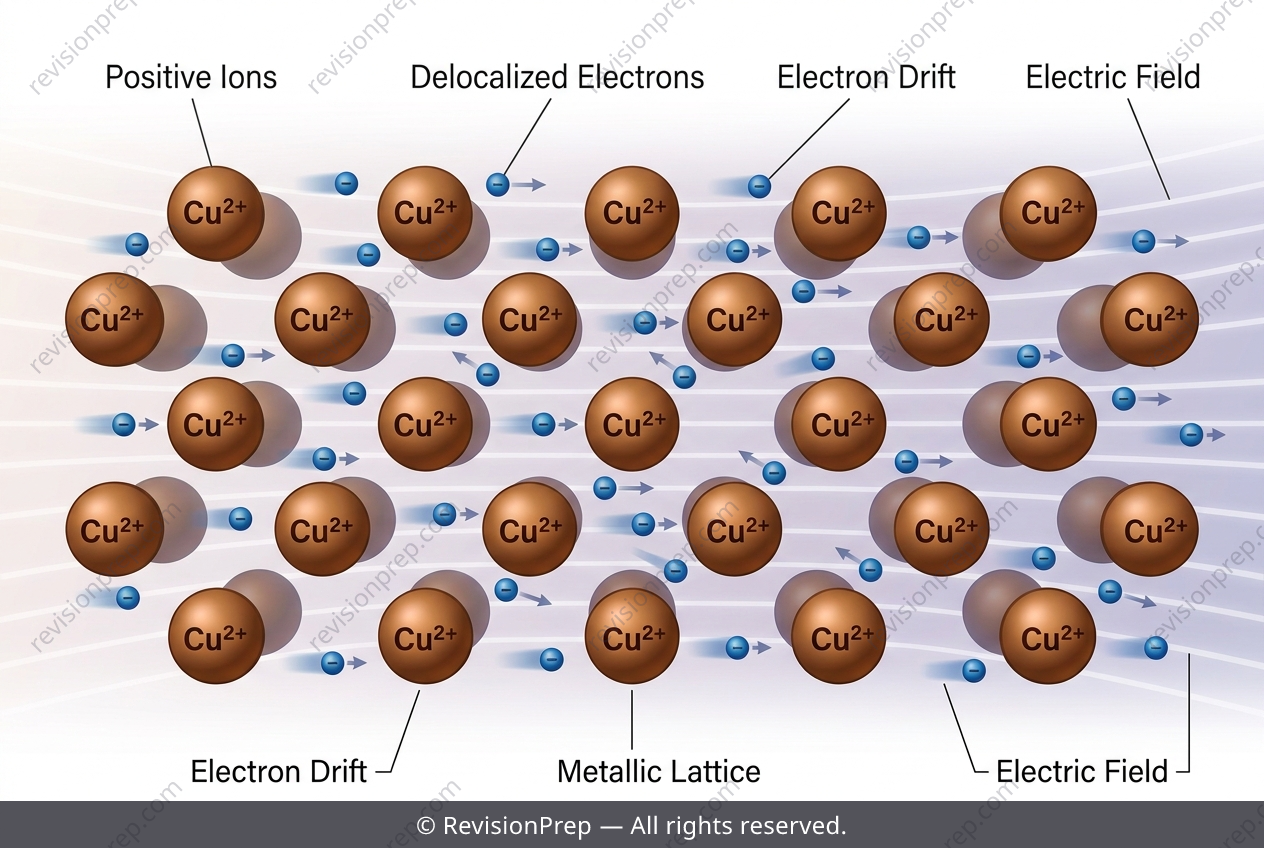
Metals like copper are the workhorses of electrical wiring, and their ability to conduct electricity hinges on a unique model of bonding. The electron sea model describes a metallic structure not as a network of discrete bonds, but as a lattice of fixed, positively charged ions immersed in a “sea” of delocalized valence electrons. These electrons are not tied to any single atom; instead, they are free to move throughout the entire three-dimensional structure, forming a mobile, negatively charged cloud that holds the positive ions together. This model directly explains conductivity. In the absence of an external field, the delocalized electrons move randomly. However, when a potential difference is applied—say, from a battery—it creates an electric field that exerts a force on these free electrons, causing them to drift directionally through the lattice. This net movement of charge is the electric current. Crucially, the positive ions remain fixed in their positions, vibrating but not migrating. Thus, the key relationship is between the mobile electron sea and the applied field: the field imposes order on the random motion, converting it into a directed flow that carries charge along the wire.
Start practising IB questions today
150,000+ IB-styled questions, criteria-mapped and instantly accessible.