
Chemistry: Hydrates, Concentration and Dilution
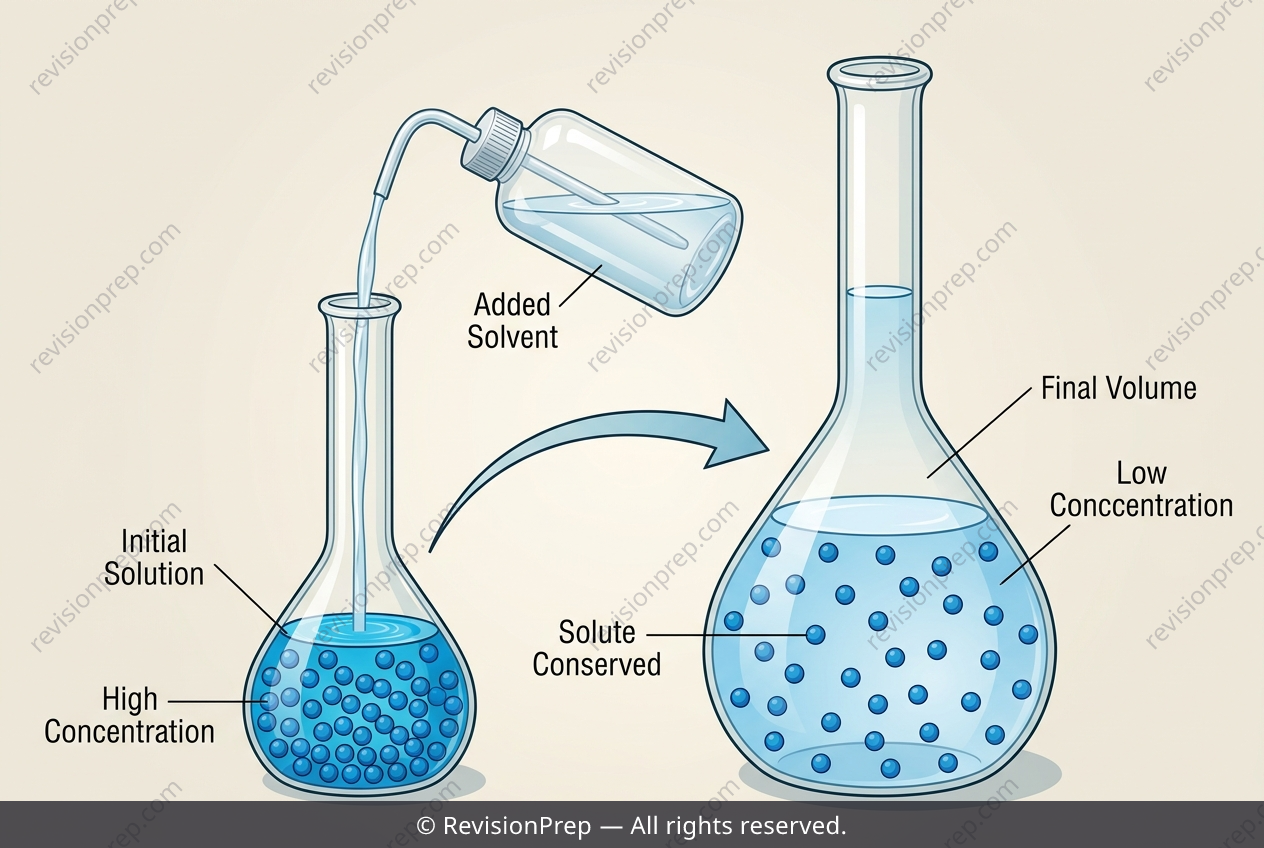
Concentration and dilution lie at the heart of nearly every quantitative chemistry experiment, from preparing a standard solution to predicting how ions behave in a reaction vessel. At its core, this topic asks a simple question: how much solute is actually present in a given volume of solution? The answer comes through the relationship concentration (mol dm⁻³) = amount of solute (mol) ÷ volume (dm³), where the amount itself is found by dividing the mass of a substance by its molar mass. What makes this concept genuinely useful is how it extends beyond a single flask. When you dissolve a hydrated salt like copper(II) sulfate pentahydrate, the water molecules trapped in the crystal lattice become part of the molar mass — so the mass you weigh out includes both the salt and its bound water. This means the molar mass calculation must account for the full formula unit. Then, when you dilute a solution by adding more solvent, the amount of solute stays constant while the volume increases, so the concentration drops proportionally. The dilution factor is simply the ratio of final to initial volume, and it directly scales the new concentration. Understanding these connections lets you track ions through mixing, dilution, and reaction stoichiometry — a skill essential for electrolysis, titrations, and any lab work involving solutions.
Start practising IB questions today
150,000+ IB-styled questions, criteria-mapped and instantly accessible.