
Chemistry: Inside the Boltzmann Curve of Reaction Rate
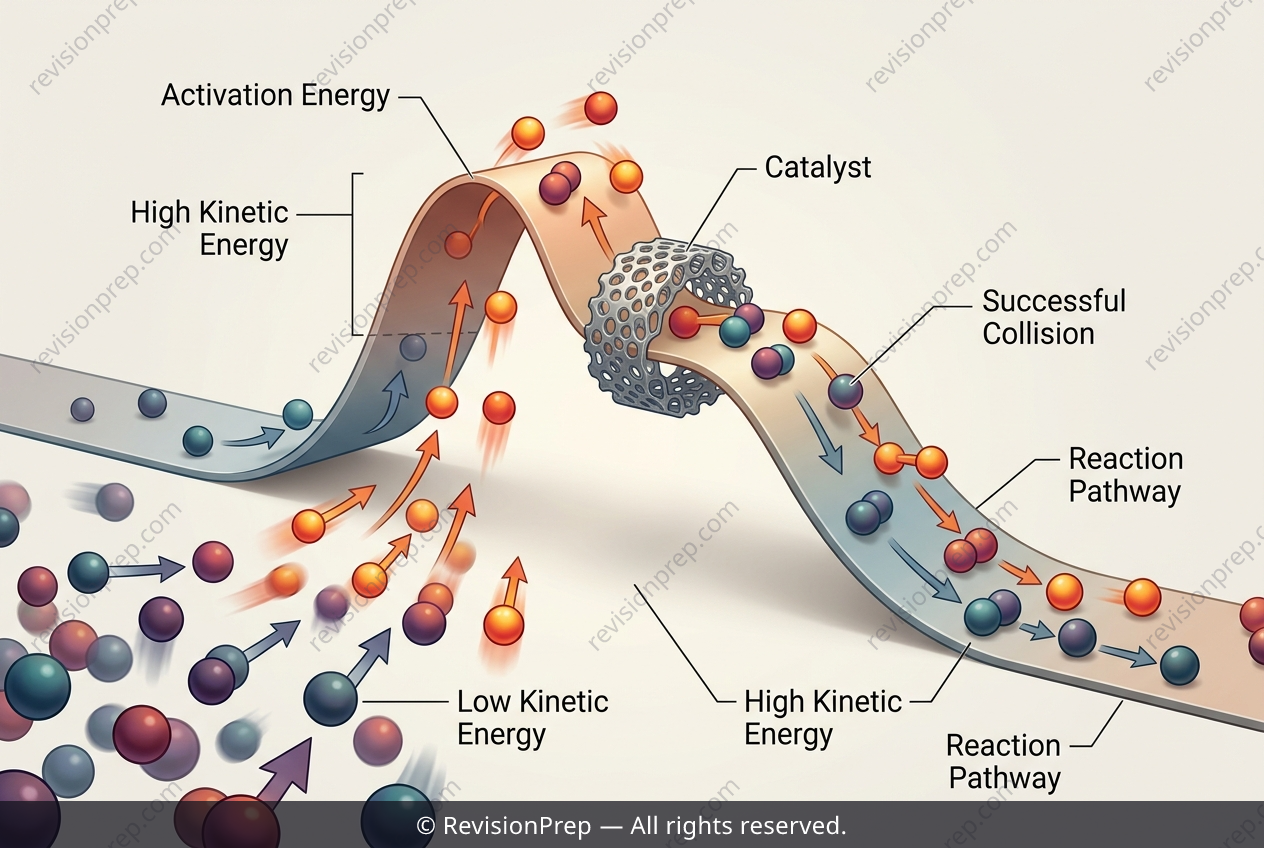
Imagine a chemical reaction as a molecular collision: for anything to happen, particles must smash into each other with enough energy to break existing bonds. This is the heart of collision theory, and it explains why the Haber process, which produces ammonia from nitrogen and hydrogen, doesn’t just run at room temperature. The core idea is that reaction rate depends not on the total number of collisions, but on the fraction of collisions that are “successful”—those that carry at least the activation energy (Ea). This fraction is visualised using a Boltzmann distribution curve, which plots the spread of molecular kinetic energies at a given temperature. This concept matters because it reveals the delicate trade-off between kinetics and equilibrium. In the exothermic Haber reaction, lower temperatures favour a higher yield of ammonia, but they also starve the system of energetic collisions, making the reaction impractically slow. Raising the temperature to 450°C shifts the distribution curve to the right, dramatically increasing the proportion of molecules with energy above the uncatalysed Ea of 230 kJ/mol. However, a catalyst changes the game entirely: by offering an alternative pathway with a lower Ea (140 kJ/mol), it enlarges the “successful” area under the curve without changing the temperature. Thus, the catalyst allows the reaction to run fast enough at a temperature that, while not optimal for yield, is commercially viable—connecting the microscopic energy landscape to macroscopic industrial choices.
Start practising IB questions today
150,000+ IB-styled questions, criteria-mapped and instantly accessible.