
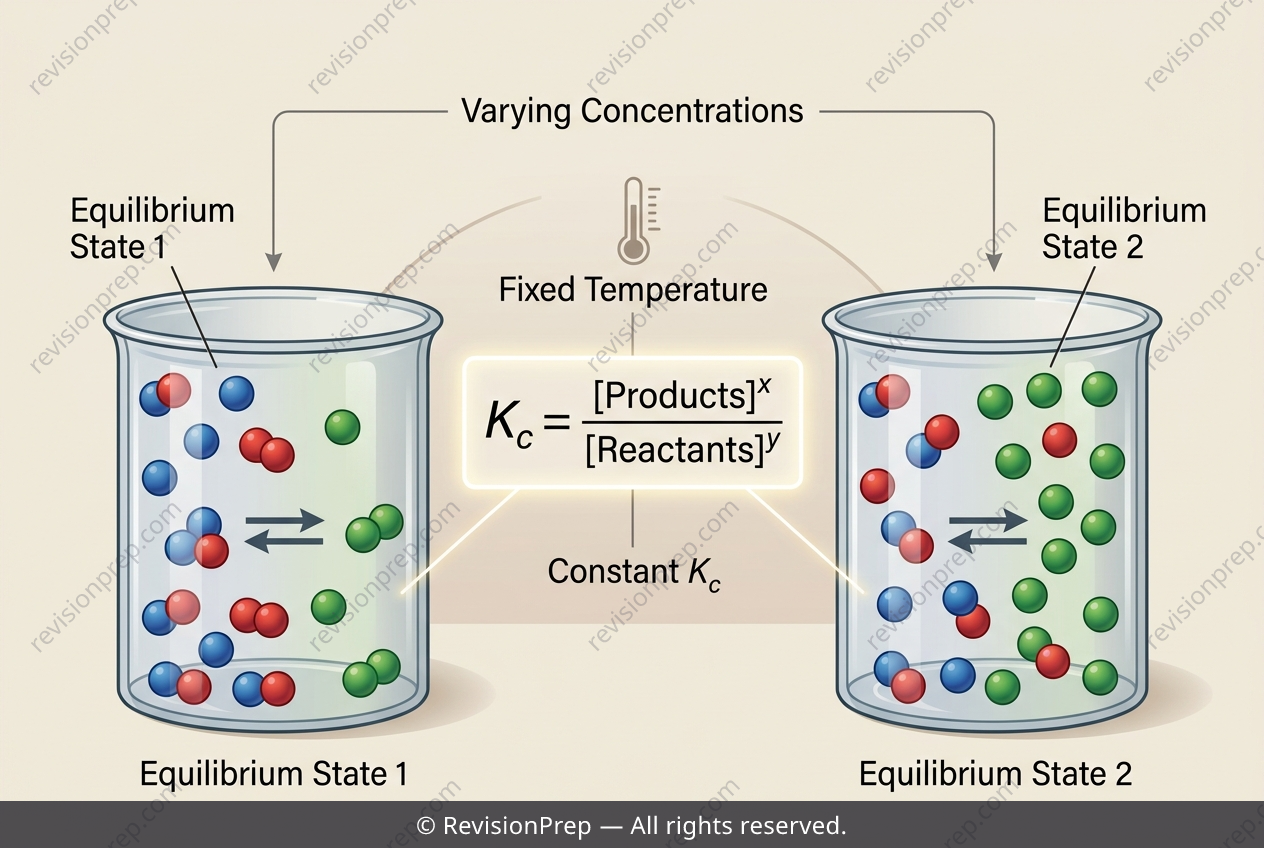
Chemistry: Kc — The Fingerprint of Equilibrium
Chemical equilibrium is the delicate balancing act of a reversible reaction—the point where the forward and reverse reactions proceed at identical rates, so concentrations of reactants and products hold steady. At the heart of this lies the equilibrium constant, Kc, a single number that captures the ratio of product concentrations to reactant concentrations, each raised to the power of their stoichiometric coefficients. For a reaction like nitrogen and hydrogen forming ammonia, Kc = [NH₃]² / ([N₂][H₂]³), this ratio is not just a snapshot—it is a fingerprint of the system at a given temperature. What makes Kc so powerful is its remarkable constancy. While individual concentrations may shift wildly depending on starting amounts, Kc remains fixed for a given reaction at a fixed temperature. This means that if you know the temperature, you know the ratio—no matter how you set up the experiment. In practice, this allows chemists to predict whether a system is at equilibrium, to calculate unknown concentrations, and to understand how changes in pressure or volume will shift the balance without altering the fundamental constant itself. The key relationship to remember: K_c depends only on temperature, not on how the equilibrium was reached.
Start practising IB questions today
150,000+ IB-styled questions, criteria-mapped and instantly accessible.