
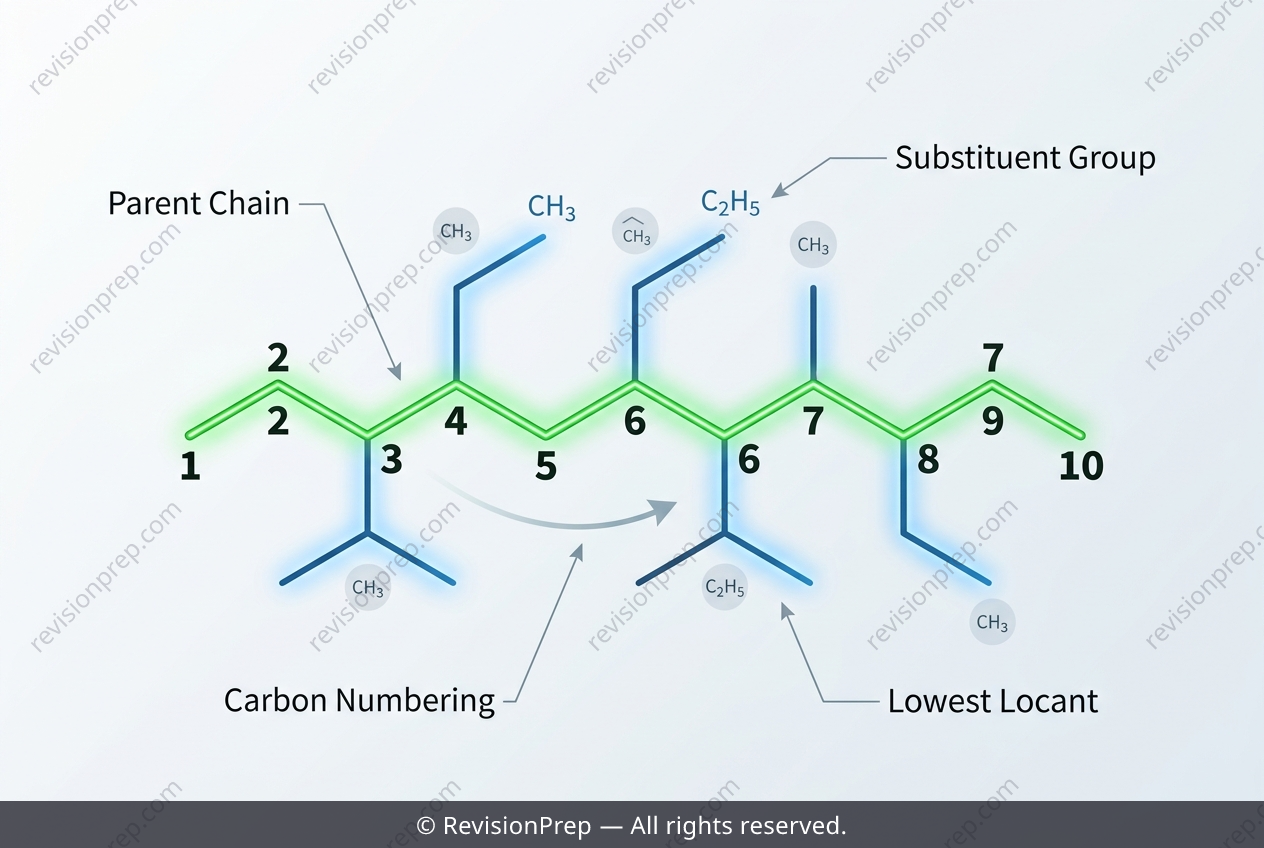
Chemistry: Longest Chain, Lowest Locant
When you look at a molecule drawn as a chain of carbon atoms, the first step toward naming it is finding the longest continuous carbon backbone. This is the foundation of IUPAC nomenclature for branched alkanes, the systematic language chemists use to ensure that every compound has one unique, universally understood name. For a structure like CH₃CH₂CH(CH₃)CH₂CH₃, the core task is to identify that parent chain, then treat any attached groups—like a methyl branch—as substituents that modify that base name. The key relationship here is between chain length and numbering. The longest chain in this molecule contains five carbons, which gives the parent name “pentane.” Once that chain is established, you number the carbons from the end that gives the substituent the lowest possible locant. In this case, the methyl group is attached to the third carbon from either end, which means the correct prefix is “3-methyl,” not “2-” or “4-.” Understanding this logic—longest chain first, then lowest locant—connects the structural formula directly to its systematic name, turning a visual jumble of atoms into a precise, rule-based label.
Start practising IB questions today
150,000+ IB-styled questions, criteria-mapped and instantly accessible.