
Chemistry: Mole Ratios Track Haber Equilibrium
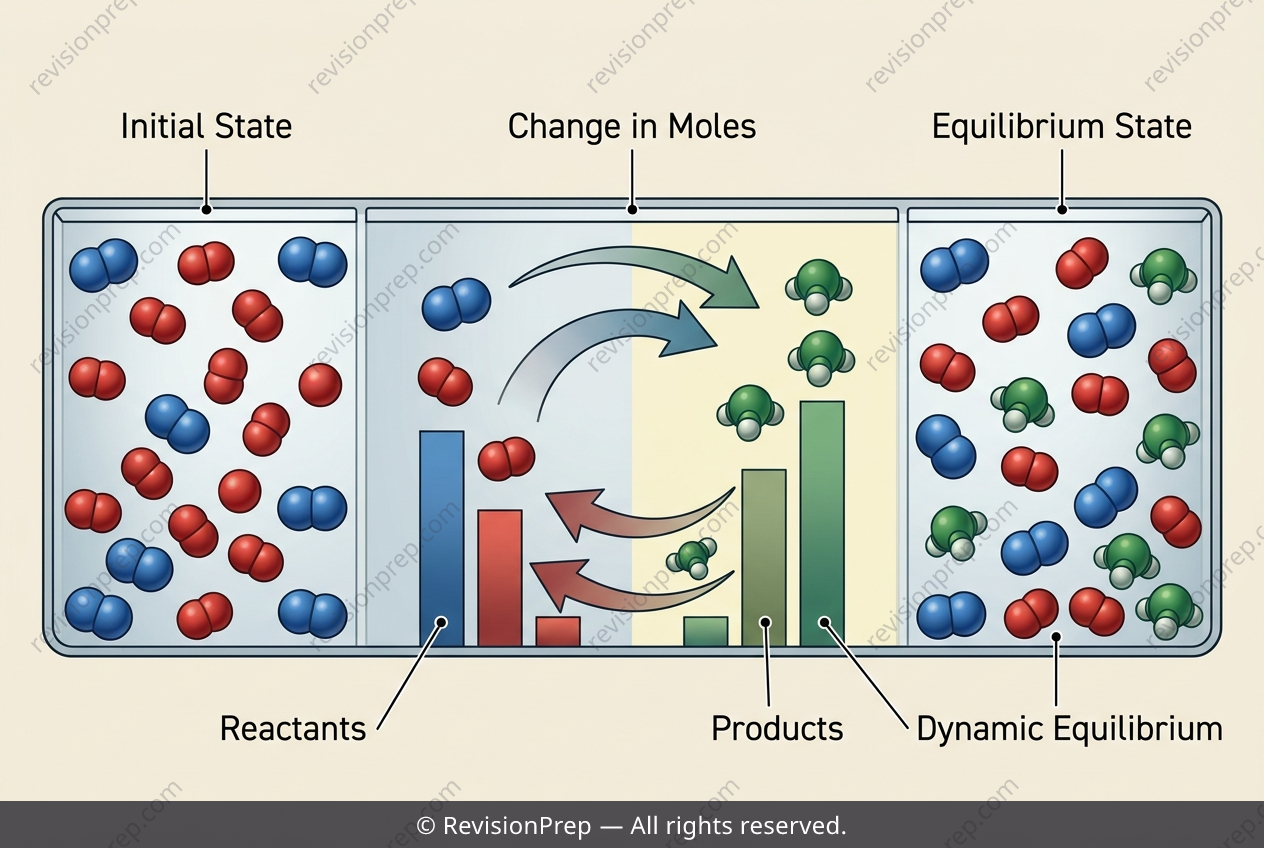
In chemical equilibrium, reactions don’t simply stop when reactants are used up; instead, they reach a dynamic balance where the forward and reverse rates are equal. For the Haber process, N₂ + 3H₂ ⇌ 2NH₃, this balance is governed by stoichiometric relationships—the fixed molar ratios that link how much of each substance is consumed and produced. Understanding these ratios is essential because they allow you to track concentration changes from initial conditions to equilibrium, even when only one species’ final amount is known. The core idea is that every mole of ammonia formed consumes half a mole of nitrogen and one and a half moles of hydrogen, based on the 1:3:2 coefficient ratio. If you know the starting concentration of N₂ and the equilibrium concentration of NH₃, you can work backwards: the amount of N₂ used is exactly half the NH₃ produced. This relationship connects the visible product concentration to the hidden reactant depletion, letting you calculate the remaining N₂. It’s a direct application of the mole ratio from the balanced equation, turning a seemingly complex equilibrium problem into a simple subtraction—provided you respect the stoichiometric coefficients.
Start practising IB questions today
150,000+ IB-styled questions, criteria-mapped and instantly accessible.