
Chemistry: Qc vs Kc — Predicting Ester Equilibrium
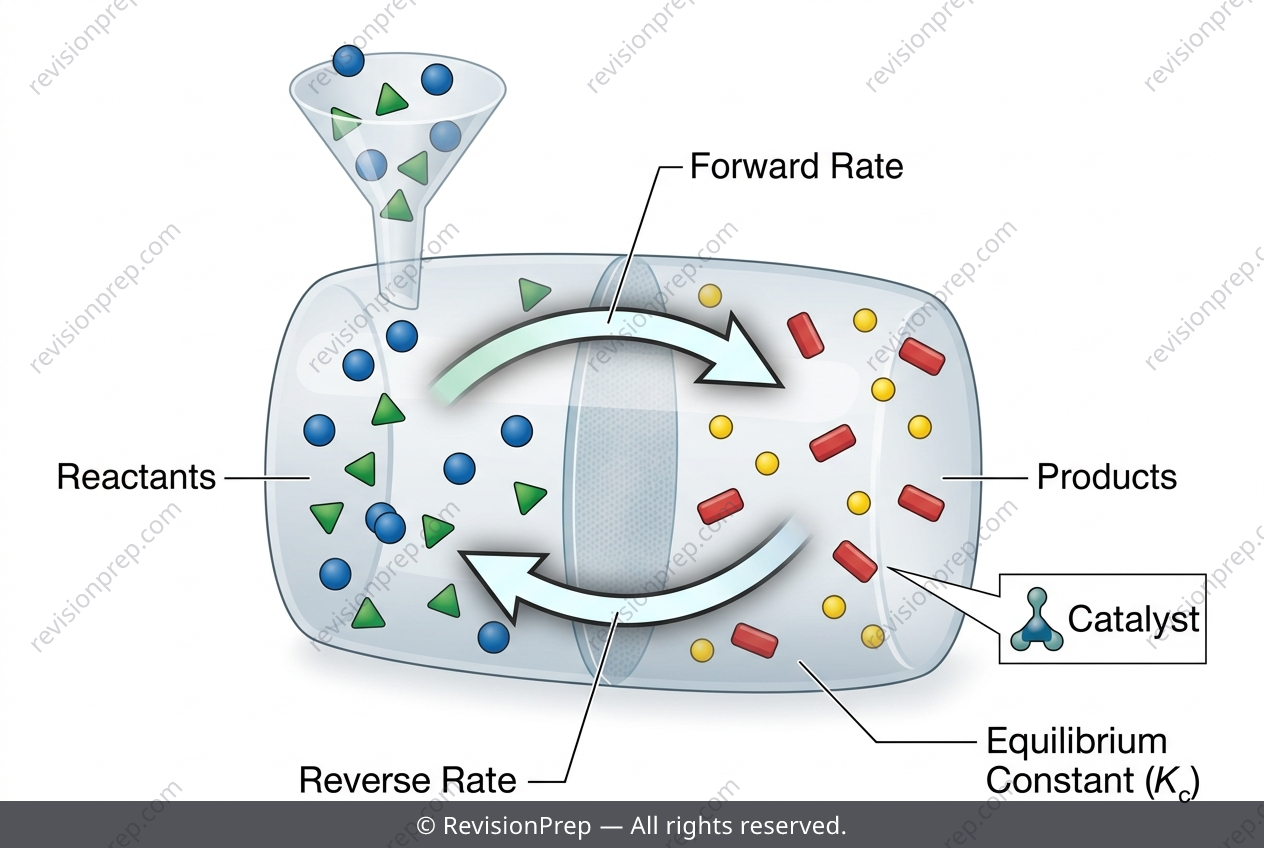
Chemical equilibrium describes the point in a reversible reaction where the forward and reverse processes occur at the same rate, meaning the concentrations of reactants and products remain constant over time. For the esterification of ethanoic acid with ethanol, this balance is quantified by the equilibrium constant, Kc, which compares the product concentrations to reactant concentrations at equilibrium. The expression Kc = [ester][water] / [acid][alcohol] shows that the value is fixed for a given temperature, making it a powerful predictor of how far a reaction will proceed. The concept matters because it explains why reactions like esterification never go to completion—instead, they settle into a dynamic balance. Using an ICE table (Initial, Change, Equilibrium) allows you to track how initial amounts shift to equilibrium values, as seen when equal moles of acid and alcohol react to form a measurable amount of ester and water. The reaction quotient, Qc, helps determine the direction of shift when conditions change, while a catalyst like sulfuric acid speeds up both directions equally without altering Kc. Understanding these relationships lets you predict equilibrium positions under different starting conditions, a core skill in reactivity studies.
Start practising IB questions today
150,000+ IB-styled questions, criteria-mapped and instantly accessible.