
Chemistry: Solving Kc for PCl₅ Decomposition
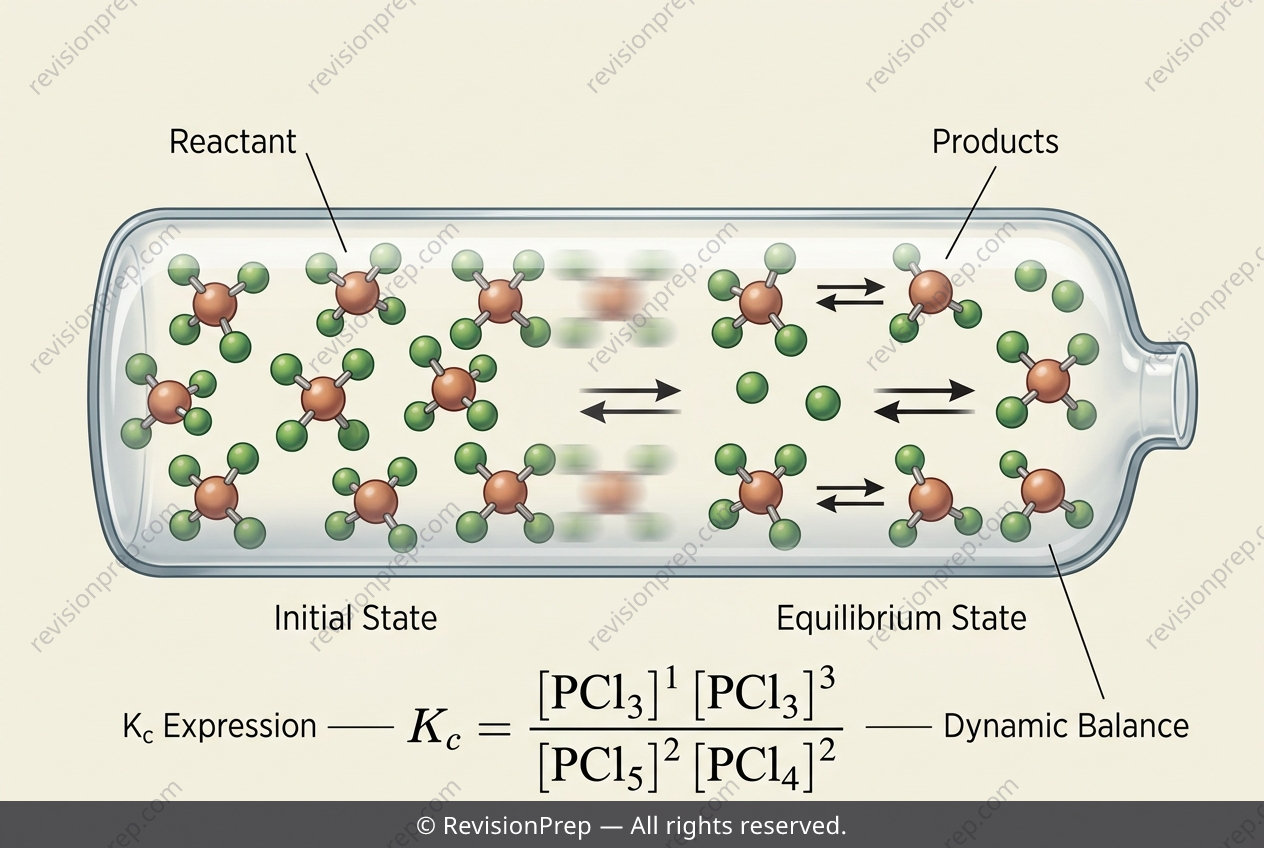
Chemical equilibrium describes the point in a reversible reaction where the forward and reverse processes occur at the same rate, leaving the concentrations of reactants and products unchanged. For the decomposition of phosphorus pentachloride, PCl₅(g) ⇌ PCl₃(g) + Cl₂(g), this dynamic balance is quantified by the equilibrium constant, Kc, which expresses the ratio of product concentrations to reactant concentrations at equilibrium. Understanding Kc is essential because it tells you the position of equilibrium—whether a reaction favours products or reactants—and allows you to predict how a system responds to changes in conditions. The key to solving equilibrium problems lies in tracking concentration changes from initial to equilibrium states. Since the stoichiometry of the reaction is 1:1:1, the amount of PCl₃ formed must equal the amount of Cl₂ formed, and both are produced at the expense of PCl₅. Starting with a known initial concentration of PCl₅, you subtract the change (equal to the equilibrium concentration of Cl₂) to find the equilibrium concentration of PCl₅. Then, substituting these equilibrium concentrations into the K_c expression—products over reactants, each raised to its stoichiometric coefficient—yields the constant, with units derived from the concentration units (mol dm⁻³). This interconnected logic—stoichiometry, initial conditions, and the equilibrium expression—forms the backbone of all equilibrium calculations.
Start practising IB questions today
150,000+ IB-styled questions, criteria-mapped and instantly accessible.