
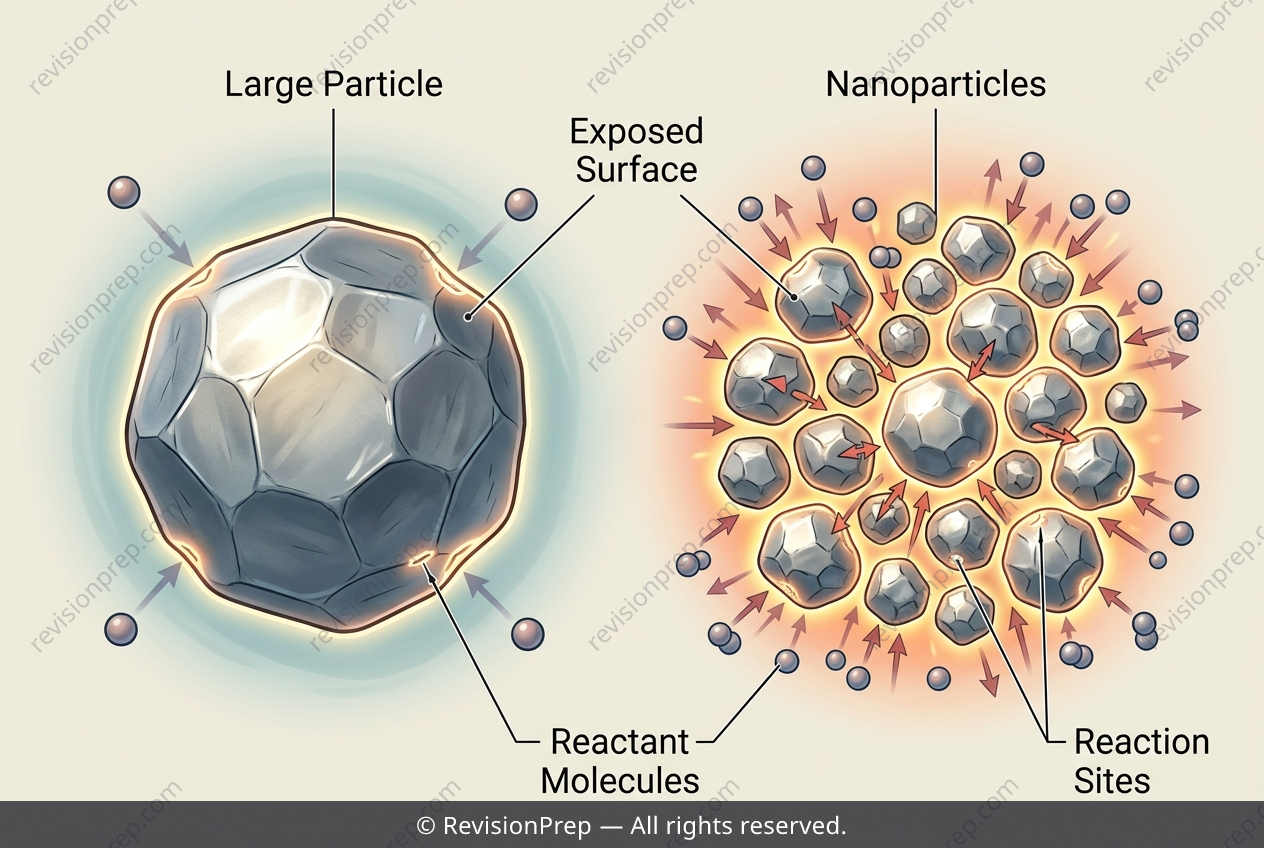
Chemistry: Surface Area Shapes Nanoparticle Reactivity
When a metal is ground down to the nanoscale, its behaviour shifts dramatically—not because its chemical identity changes, but because its physical geometry alters how many atoms are available to react. The key lies in the surface area to volume ratio (SA:V), a relationship that grows exponentially as particle size shrinks. For a cube, SA:V = 6/side length, meaning that halving the side length doubles the ratio; for spheres, the same principle applies with SA:V = 3/radius. This ratio determines the proportion of atoms sitting on the surface versus buried in the interior. Surface atoms are the only ones that can collide with reactants, form new bonds, or catalyse reactions. In a large particle, most atoms are locked inside, shielded from the environment. In a nanoparticle, however, a far greater fraction of atoms are exposed—sometimes over 50% for particles just a few nanometres across. This exposure directly correlates with reactivity: more accessible atoms mean more potential reaction sites per unit mass. The effect is purely geometric, not compositional. Density, melting point, and chemical makeup remain unchanged; what shifts is the sheer availability of reactive surface. This principle underpins applications from catalysis to drug delivery, where controlling particle size controls how aggressively a substance interacts with its surroundings.
Start practising IB questions today
150,000+ IB-styled questions, criteria-mapped and instantly accessible.