
Chemistry: The Algebra of Polyatomic Ions
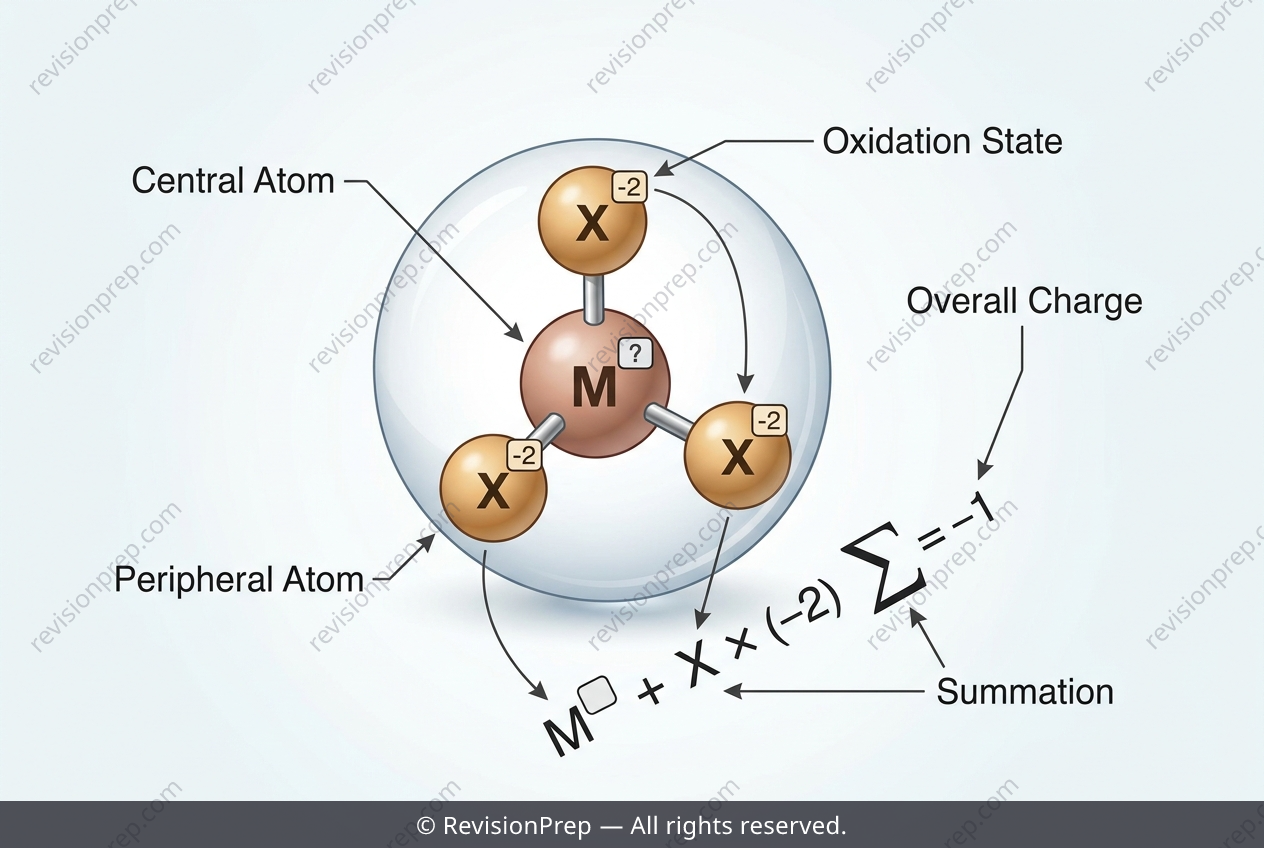
Oxidation states are the bookkeeping system chemists use to track electrons in compounds and ions. At its heart, the concept assigns a hypothetical charge to each atom, assuming that all bonding electrons are transferred to the more electronegative element. This simple tool transforms a complex molecule into a set of manageable numbers, revealing which atoms are electron-rich or electron-poor and predicting how they will behave in redox reactions. For polyatomic ions, the rules become a balancing act. The sum of all oxidation states must equal the ion’s overall charge, while oxygen almost always carries a state of −2. In a species like the vanadyl ion (VO₂⁺), the two oxygens contribute a fixed negative total, and the ion’s positive charge must be offset by the metal centre. By setting up the equation—where the vanadium state plus the oxygen contribution equals the net charge—you can solve for the unknown. This relationship between fixed oxygen values, the ion’s charge, and the variable metal state is the core logic behind determining oxidation numbers in any polyatomic ion, from permanganate to dichromate.
Start practising IB questions today
150,000+ IB-styled questions, criteria-mapped and instantly accessible.