
Chemistry: The Cold Truth About Solubility
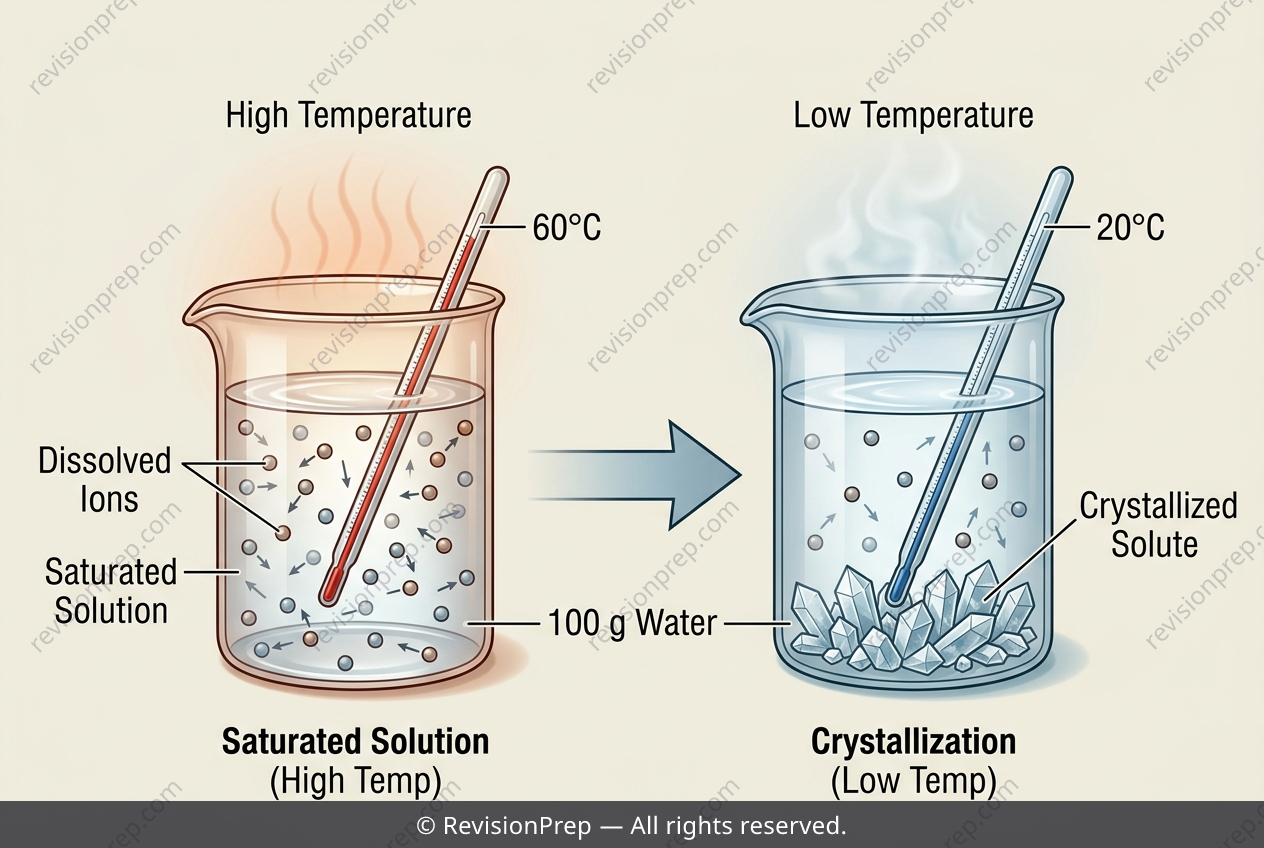
When a saturated solution is cooled, the solvent’s capacity to hold dissolved solute shrinks, forcing the excess solute to leave the solution as a solid. This is the essence of temperature-dependent solubility: at higher temperatures, more solute can remain dissolved; at lower temperatures, less can. For ionic compounds like potassium nitrate, this means that as the solution cools, K⁺ and NO₃⁻ ions pair up and crystallise out, directly reducing the number of free ions in the liquid. The relationship is quantitative and anchored to the solvent’s mass, not its volume. Solubility is defined as grams of solute per 100 grams of water, so the amount that can stay dissolved at any temperature scales linearly with the water present. When you cool a fixed mass of water from 60°C to 20°C, the difference between the two solubility values tells you exactly how much solute must precipitate. This concept matters because it links temperature, concentration, and phase change—core ideas in reactivity and equilibrium—and explains everyday phenomena from recrystallisation in labs to why sugar crystallises in honey.
Start practising IB questions today
150,000+ IB-styled questions, criteria-mapped and instantly accessible.