
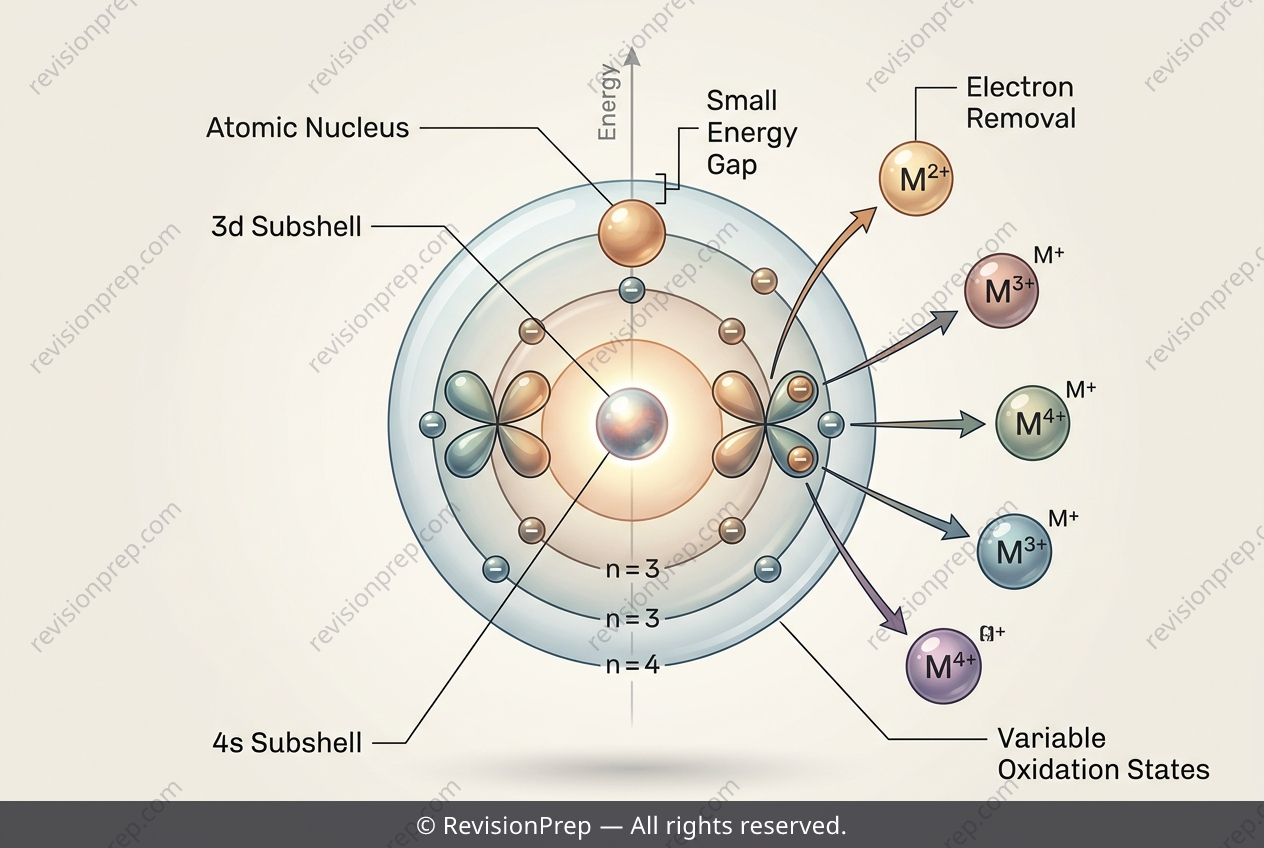
Chemistry: The Electron Gap Behind Vanadium
Transition metals like vanadium are defined by their ability to adopt multiple oxidation states, a property that stems directly from their unique electronic configurations. For vanadium, with the electron arrangement [Ar] 3d³ 4s², the key lies in the partially filled 3d subshell and the remarkably small energy gap between the 3d and 4s orbitals. This near-degeneracy means that removing electrons does not require a dramatic energy jump, allowing the atom to lose a variable number of electrons—from just one or two up to all five—depending on the chemical environment. This flexibility is what makes vanadium so versatile in redox chemistry, appearing in compounds with oxidation states ranging from +2 to +5. The partially filled d subshell is the structural reason behind this behavior: because the 3d and 4s energy levels are so close, the ionisation energies for successive electron removals are comparable, rather than sharply increasing. Consequently, vanadium can form stable ions with different charges, each exhibiting distinct colors and reactivity. Understanding this electronic basis not only explains vanadium’s chemistry but also illuminates why transition metals, as a group, are so valuable in catalysis and materials science.
Start practising IB questions today
150,000+ IB-styled questions, criteria-mapped and instantly accessible.