
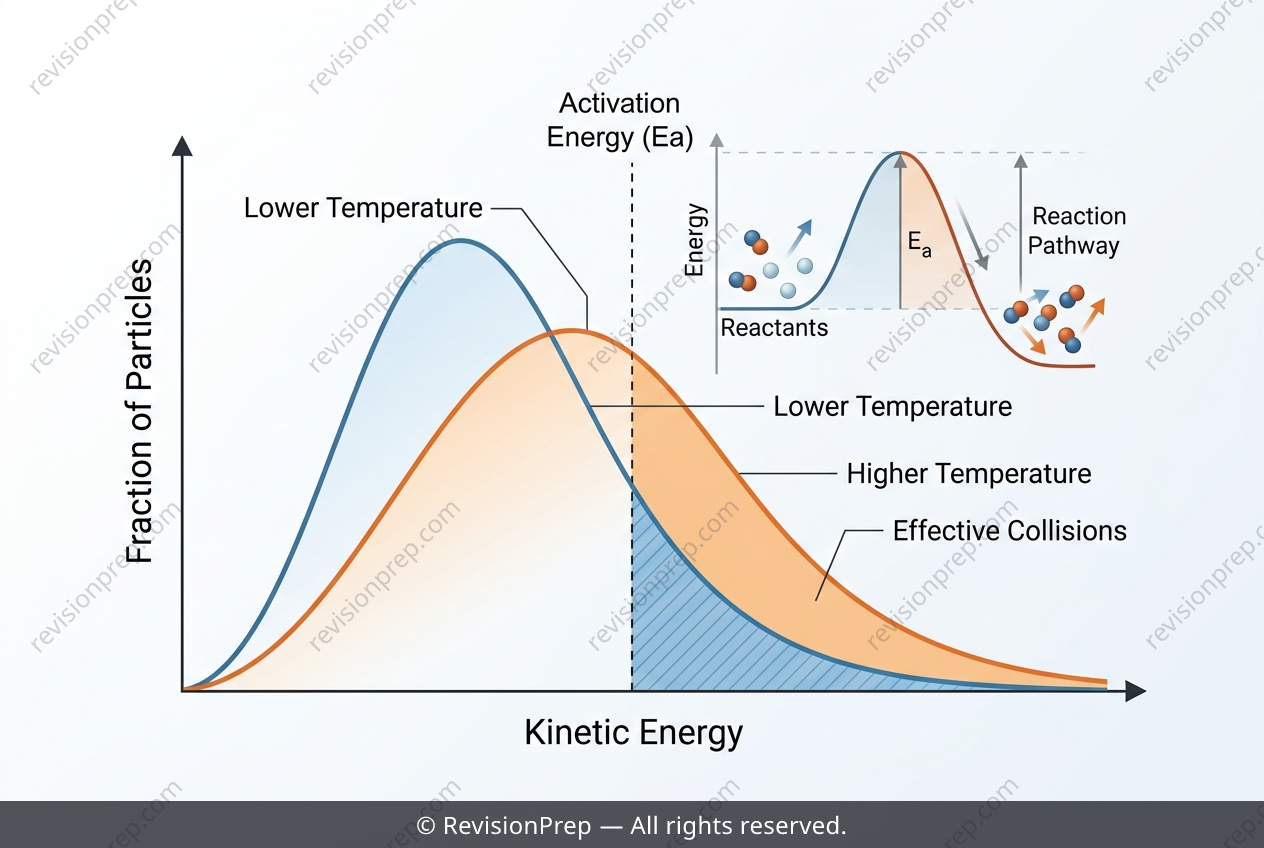
Chemistry: The High-Energy Tail That Drives Rates
The Maxwell–Boltzmann distribution is the statistical fingerprint of particle energies in a gas or liquid, and it holds the key to understanding why reaction rates are so exquisitely sensitive to temperature. At its core, the distribution shows that while most particles possess moderate energy, a small but critical fraction has energy exceeding the activation energy (Ea) — the minimum energy required for a collision to result in a reaction. This “high-energy tail” is the only population that actually drives chemistry forward. What makes this concept so powerful is its non-linear response to heating. When temperature rises, the entire curve shifts and flattens: the average kinetic energy increases only modestly (by roughly 1.7% for a 10 °C rise), yet the area under the curve beyond Ea grows dramatically. This disproportionate jump in the number of “reactive” particles — not the total particle count, nor a change in collision frequency — explains why a small temperature increase can double or triple a reaction rate. The relationship between the tiny gain in average energy and the large gain in reactive fraction is the essence of why catalysts and temperature control are so central to chemical reactivity.
Start practising IB questions today
150,000+ IB-styled questions, criteria-mapped and instantly accessible.