
Chemistry: The LCM Method Behind Ionic Formulas
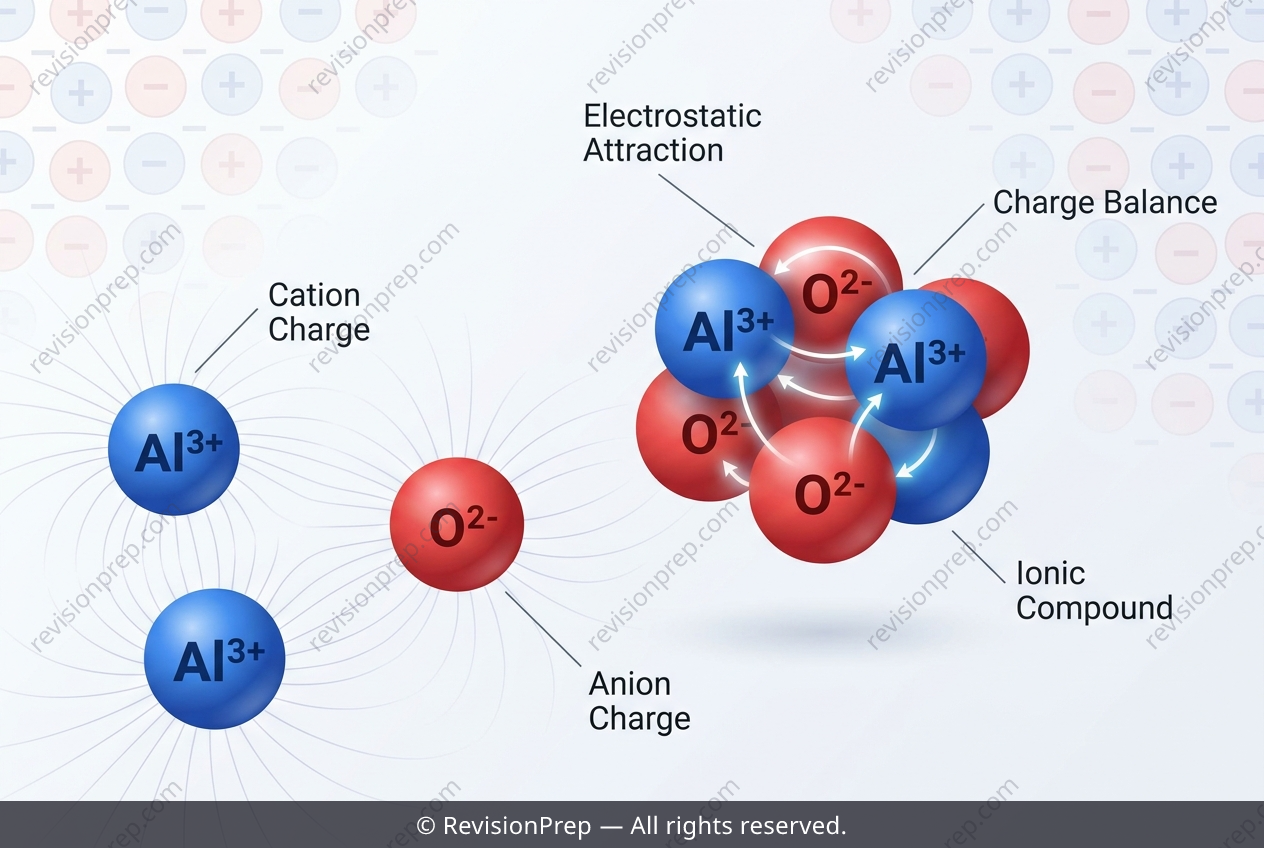
Ionic compounds are held together by the electrostatic attraction between oppositely charged ions, but for that lattice to exist, the overall charge must balance to zero. This principle—charge neutrality—is the foundation of every chemical formula you will write in Structure 2, because it dictates the exact ratio in which cations and anions combine. The key is to find the lowest common multiple of the ion charges. For aluminium, which forms Al³⁺, and oxygen, which forms O²⁻, the smallest number divisible by both 3 and 2 is 6. This means you need two Al³⁺ ions to contribute a total of +6, and three O²⁻ ions to contribute a total of −6. Only when these positive and negative totals cancel perfectly does the compound become electrically neutral, allowing the formula to be written with whole-number subscripts that reflect this balanced ratio.
Start practising IB questions today
150,000+ IB-styled questions, criteria-mapped and instantly accessible.