
Chemistry: The Missing CO₂ in a Yield Calculation
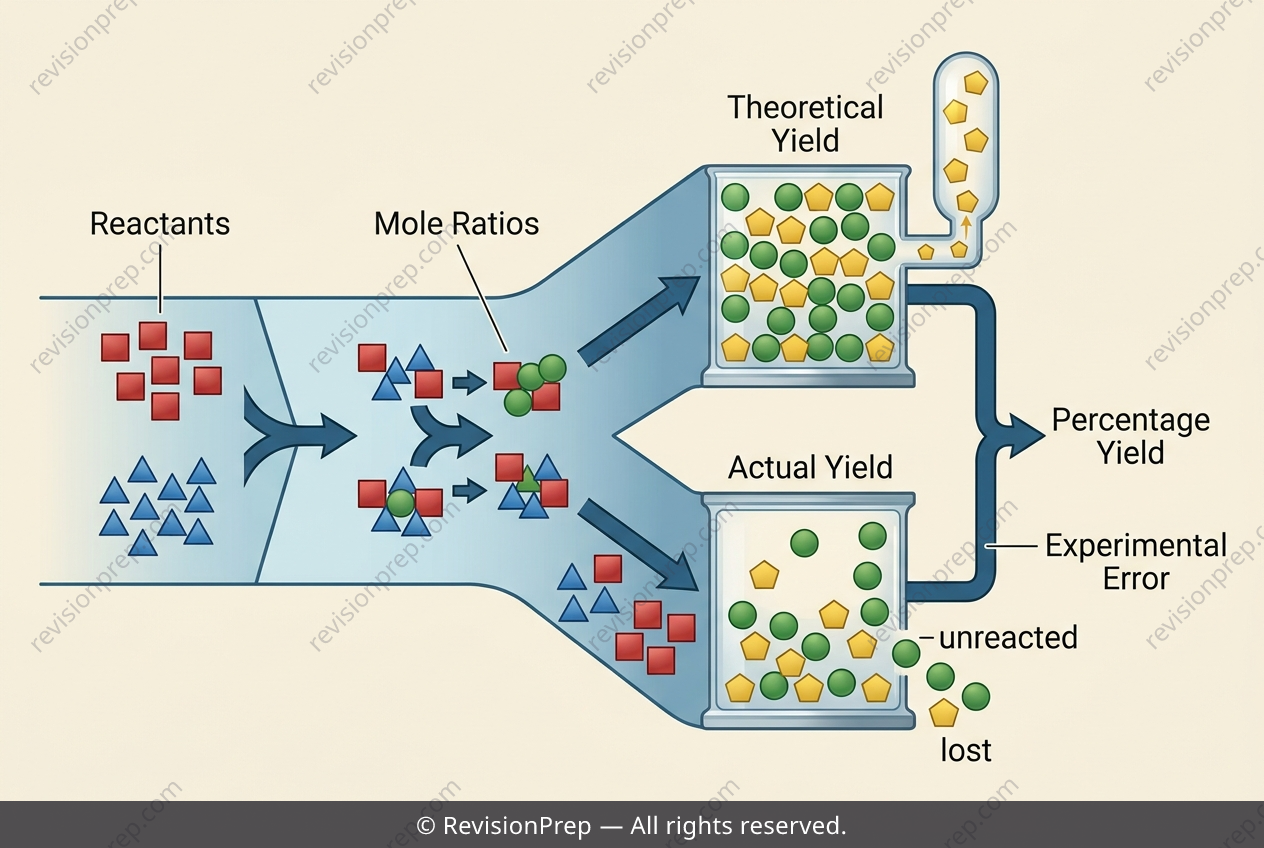
Stoichiometry is the quantitative relationship between reactants and products in a chemical reaction, and it forms the backbone of predicting how much product a reaction should yield. In this investigation, you balance the equation between sodium carbonate and hydrochloric acid, then use molar mass to convert a measured mass of reactant into moles. That mole ratio—one mole of carbonate producing one mole of carbon dioxide—lets you calculate the theoretical volume of gas at room temperature and pressure, using the molar volume of 24.0 dm³ mol⁻¹. But real experiments rarely match theory perfectly. The actual volume of gas collected in the syringe is often lower than the theoretical value, and the percentage yield formula—(actual ÷ theoretical) × 100—quantifies that gap. Here, the shortfall arises because carbon dioxide is slightly soluble in water, dissolving to form carbonic acid and never reaching the syringe. Understanding this link between balanced equations, mole calculations, and experimental error is essential: it turns a simple gas collection into a powerful tool for evaluating both reaction efficiency and the limitations of laboratory technique.
Start practising IB questions today
150,000+ IB-styled questions, criteria-mapped and instantly accessible.