
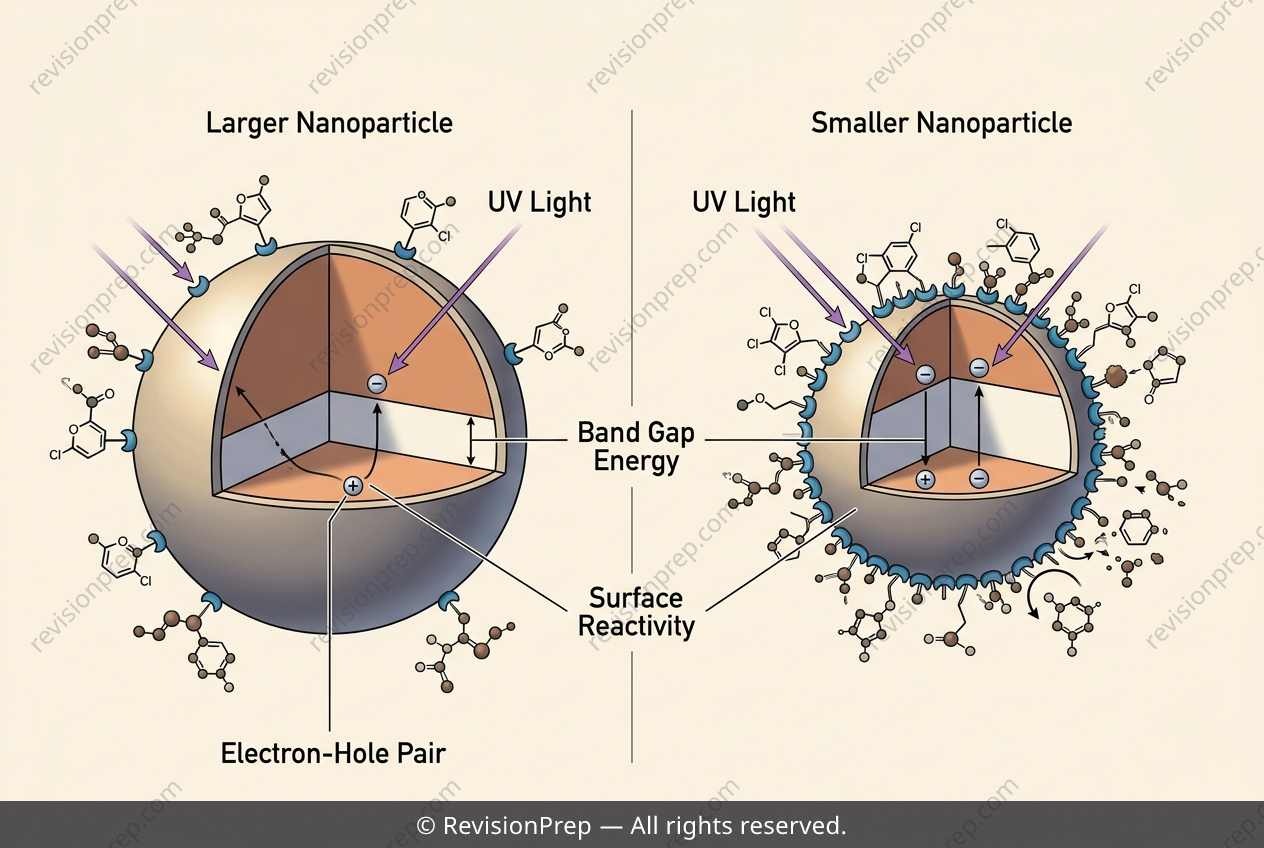
Chemistry: The Nanoscale Trade-off Behind TiO₂ Coatings
Nanoparticles don’t just shrink a material—they rewrite its electronic personality. In titanium dioxide (TiO₂), used in self-cleaning window coatings, this shift is what turns an ordinary semiconductor into a photocatalyst that breaks down organic grime under UV light. The core idea here is that at the nanoscale, quantum confinement raises the band gap energy above its bulk value, while simultaneously boosting the surface area to volume ratio—two effects that pull in opposite directions for catalytic performance. Why does this matter? Because the balance between these effects determines whether a coating actually works in real-world light conditions. The band gap energy for a spherical nanoparticle follows E_g = 3.0 + 0.75/r² (with r in nm), meaning smaller particles need higher-energy photons to excite electron–hole pairs. Yet that same size reduction multiplies the surface area to volume ratio (3/r), offering far more active sites for the breakdown reaction. So a 1.5 nm particle may have a wider band gap requiring shorter-wavelength UV, but it also presents a dramatically larger catalytic surface than a 10 nm particle. The real insight is that “better” isn’t absolute—it depends on whether the available light can bridge that larger gap, and whether the environmental benefits of more active sites outweigh the practical limits of UV activation.
Start practising IB questions today
150,000+ IB-styled questions, criteria-mapped and instantly accessible.