
Chemistry: The Nuclear Grip Behind Ionization Energy
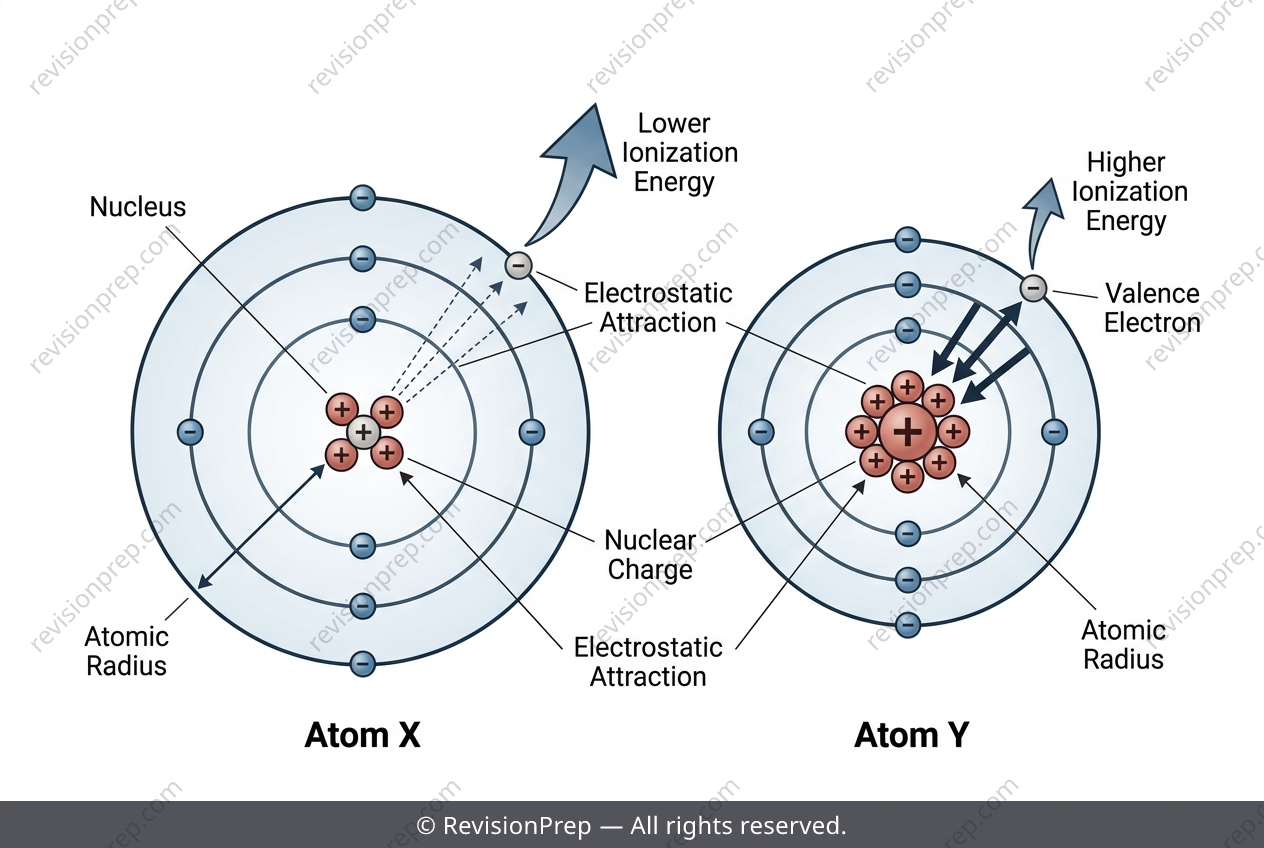
First ionization energy measures the energy required to remove the most loosely held electron from a gaseous atom. It is a fundamental periodic trend that reveals how strongly an atom’s nucleus attracts its outermost electrons—a balance between nuclear charge, shielding by inner electrons, and atomic radius. Across a period, such as from sodium to magnesium, the nuclear charge increases while the atomic radius shrinks. This happens because added protons pull the same outer shell closer, and the inner electrons do not fully shield the increased positive charge. As a result, the outer electrons in magnesium feel a stronger net attraction to the nucleus than those in sodium, making them harder to remove. While a filled subshell can add stability, the dominant factor here is the combined effect of greater nuclear charge and smaller atomic radius—not electron configuration alone. Understanding this interplay helps predict why ionization energy generally rises across a period and explains the relative ease of removing electrons from different elements.
Start practising IB questions today
150,000+ IB-styled questions, criteria-mapped and instantly accessible.