
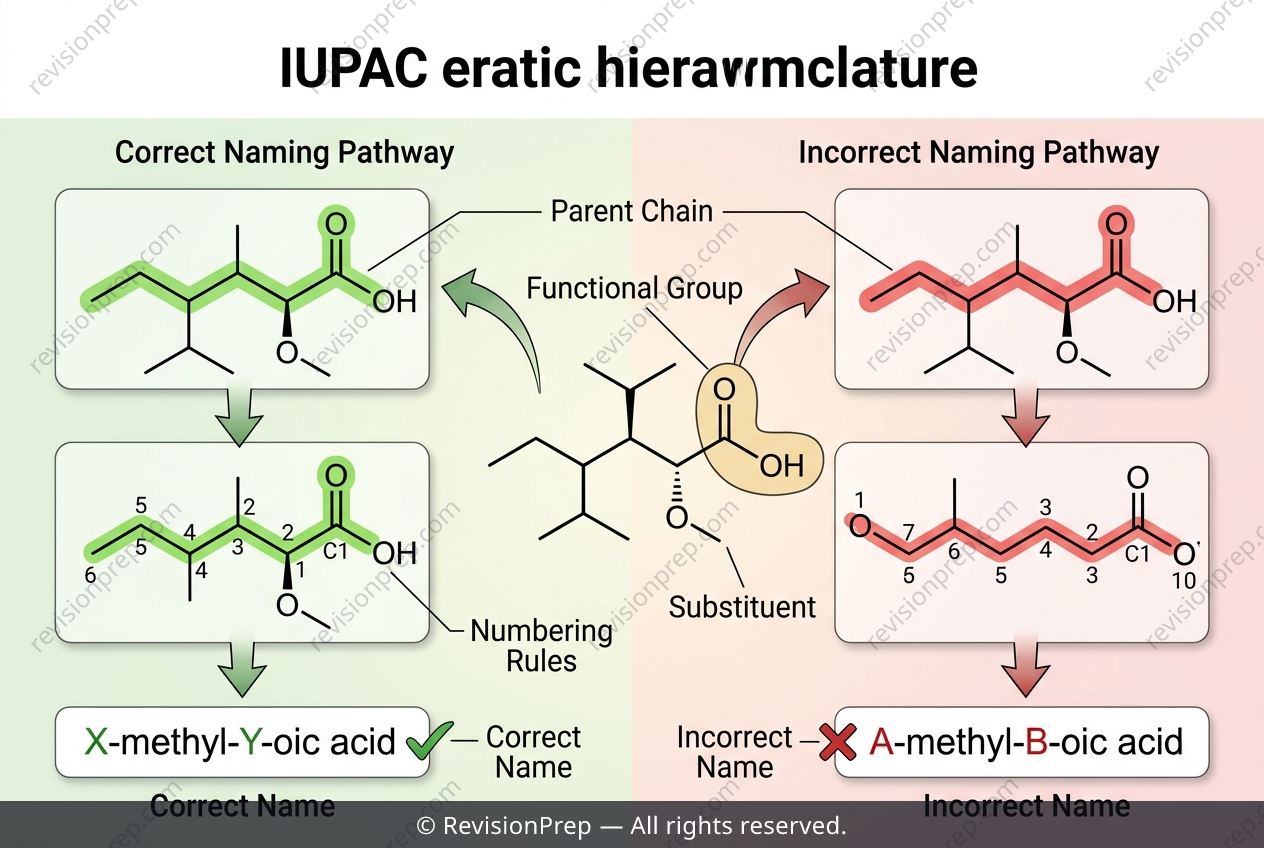
Chemistry: The Number That Can Misname a Molecule
Naming organic compounds is the language of chemistry—a precise system that ensures a molecule’s structure is communicated unambiguously, whether in a lab notebook or a pharmaceutical dossier. For carboxylic acids, the IUPAC rules place the carboxyl carbon (the –COOH group) at position 1, making it the anchor for all numbering. This single decision dictates every substituent’s locant, and getting it wrong can misidentify a compound entirely, as seen when a quality control lab reports “4-methylpentanoic acid” for a molecule that is actually 3-methylbutanoic acid. The distinction hinges on the lowest-locant rule: because the carboxyl carbon must be C1, the methyl branch in this structure falls on C3, not C4—numbering from the opposite end would violate the priority given to the principal functional group. Beyond nomenclature, the same structural formula connects to stoichiometry through the molar mass (M = 102.13 g mol⁻¹). Using n = m/M, a given mass of the sample can be converted into moles, linking the compound’s identity to its measurable quantity—a fundamental step in any quantitative analysis, from drug synthesis to purity checks.
Start practising IB questions today
150,000+ IB-styled questions, criteria-mapped and instantly accessible.