
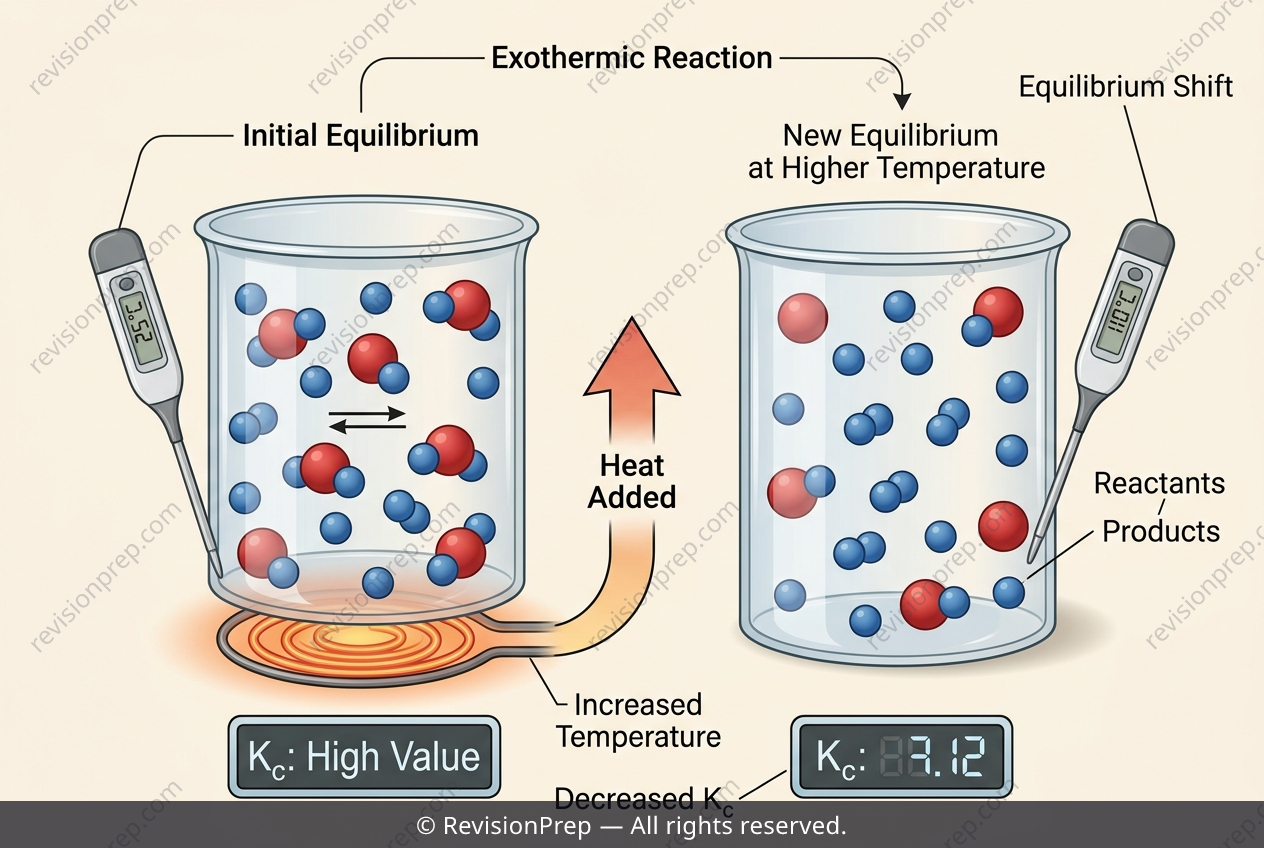
Chemistry: Van’t Hoff — Linking Kc and Temperature
Le Chatelier’s Principle is the compass for predicting how a chemical system at equilibrium responds to disturbance—whether you alter concentration, pressure, or temperature. For reactions where heat is a product or reactant, temperature changes do more than just shift the equilibrium position; they also fundamentally alter the equilibrium constant itself, Kc. This dual effect is central to understanding industrial processes like the Haber process, where optimizing yield requires balancing kinetic speed against thermodynamic limits. The key relationship here is the van’t Hoff equation, which shows that Kc depends exponentially on temperature. For an exothermic forward reaction (ΔH < 0), increasing temperature decreases Kc, meaning the ratio of products to reactants at equilibrium falls. Simultaneously, the system responds by favouring the endothermic reverse reaction to absorb the added heat, shifting the position of equilibrium to the left. These two effects—a smaller Kc and a leftward shift—are not independent; they are two expressions of the same thermodynamic reality. Understanding this connection explains why industrial ammonia synthesis operates at a compromise temperature: high enough for a fast rate, but low enough to keep Kc favourable.
Start practising IB questions today
150,000+ IB-styled questions, criteria-mapped and instantly accessible.